Quick answer
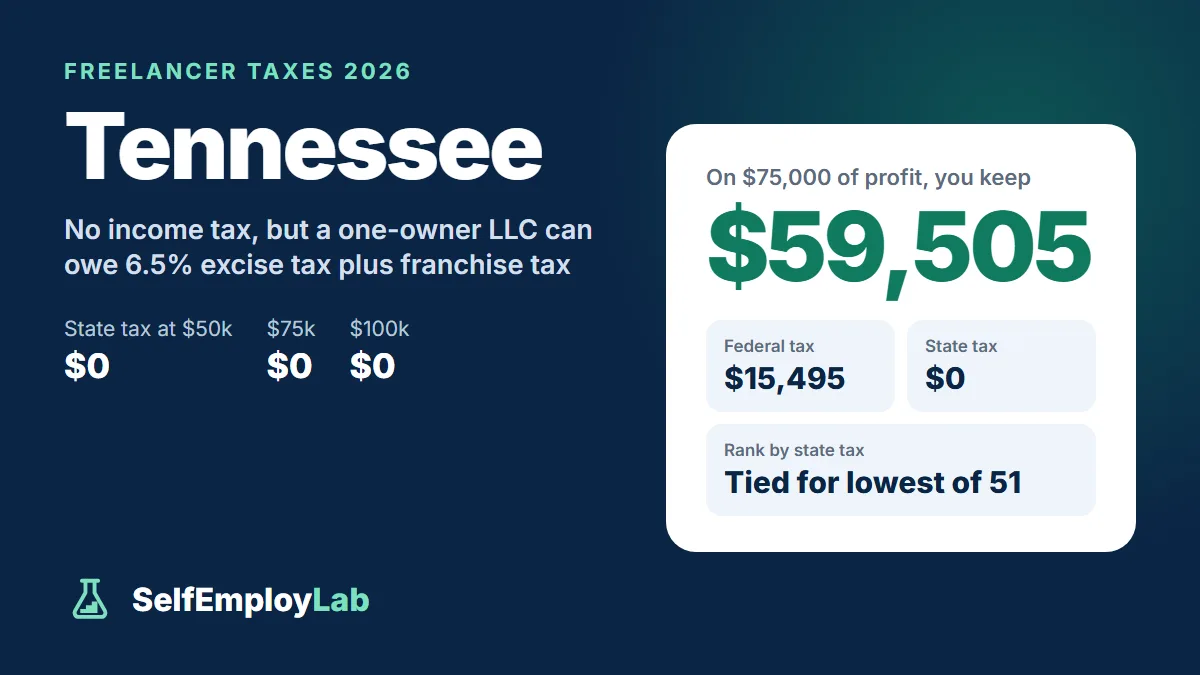
A single freelancer in Tennessee with $75,000 of profit pays no Tennessee income tax in 2026, but still owes about $15,495 of federal tax (self-employment tax of 15.3% on 92.35% of profit plus income tax), keeping about $59,505. A one-owner LLC can still owe Tennessee franchise and excise tax.
Tennessee doesn’t tax wages or business income, and since the Hall tax on interest and dividends was fully repealed in 2021, it has no personal income tax at all. But Tennessee is not tax-free for businesses: it has a business tax on gross receipts, and an LLC can owe franchise and excise tax that a sole proprietor never sees. Here is what a Tennessee freelancer actually owes.
How Tennessee compares: in our 50-state take-home pay ranking, a single freelancer with $75,000 of profit keeps $59,505 in Tennessee after federal and state income tax, tied for 1st of 51 with the other places that charge this freelancer no state income tax.
Set aside from every payment
—
That is $0 of every $1,000 you receive
- Federal income tax share
- —
- Self-employment tax share
- —
- State tax share
- —
- Total to save this year
- —
Estimate for information only — not tax, legal or financial advice. Federal figures for tax year 2026; state and local taxes are not included unless you enter them. Check your situation with a CPA or enrolled agent.
What you pay on freelance profit in Tennessee
| Tax | Applies to Tennessee freelancers? |
|---|---|
| Federal self-employment tax (15.3%) | Yes |
| Federal income tax (10%–37%) | Yes |
| State personal income tax | No |
| Tennessee business tax (gross receipts) | A license above $3,000 of gross receipts; a state return and tax once you reach $100,000 |
| Franchise and excise tax | Only if you operate through an entity such as an LLC — sole proprietors are exempt |
| Sales tax | Only if you sell taxable goods or taxable services |
Self-employment tax ≈ $12,010 and federal income tax ≈ $5,790, for about $17,800 total — and no income tax to the state. That works out to about $4,450 per quarter in federal estimated tax. Check your own numbers with the quarterly estimated tax calculator.
The Tennessee business tax
Tennessee’s business tax is a tax on gross receipts, charged by both the state and the city or county where you do business. It applies to sole proprietors as well as entities, and what you owe depends on your sales at each location:
- $3,000 or less in gross receipts: no business license is required.
- More than $3,000 but less than $100,000: you need a minimal activity license from your county clerk (and city, if you’re inside city limits), renewed each year. You generally don’t file a state business tax return.
- $100,000 or more: you need a standard business license and must file an annual business tax return with the Department of Revenue. Calendar-year filers’ returns are due April 15. The tax is a small fraction of a percent of gross receipts, set by your business classification, with a minimum of $22 per location ($44 inside a city, since both state and city tax apply).
Some services are exempt from the business tax — accounting and architecture are among them — but the exemptions are narrow and apply only to the receipts from that specific service. Consulting, for example, is not exempt.
If you have an LLC: franchise and excise tax
This is the big Tennessee surprise. Tennessee does not treat a single-member LLC owned by an individual as a disregarded entity for franchise and excise tax, even though the IRS does. That means an LLC generally owes:
- Excise tax of 6.5% of its net earnings, and
- Franchise tax of $0.25 per $100 of Tennessee net worth, with a $100 minimum even in a year with no activity.
A sole proprietor operating under their own name owes neither. Some LLCs can qualify for an obligated member entity exemption, which depends on the members giving up their limited liability protection, so check the Department of Revenue’s rules before you rely on it. Tennessee LLCs also file an annual report with the Secretary of State; the fee starts at $300. Run these costs before forming an LLC or making an S corp election — in Tennessee, the LLC can cost you real tax, not just paperwork.
Sales tax on services
Tennessee’s state sales tax is 7%, plus local taxes. Services are taxable only when the law specifically lists them, so most professional services such as writing, design and consulting are not. Repair and installation services and any physical products you sell generally are. If your work could fall into a taxable category, check with the Tennessee Department of Revenue before you assume you don’t need to register.
Paying your taxes
With no state income tax, your only estimated payments are federal: April 15, June 15 and September 15, 2026, and January 15, 2027. See how to pay estimated taxes online.
How much to set aside
Tennessee freelancers only need to cover federal income and self-employment tax, plus small business tax amounts. In the tax set-aside calculator, leave the state rate at 0. For a single freelancer that is typically around 17%–24% of profit, depending on income. If you operate through an LLC, set aside extra for the 6.5% excise tax.
Frequently asked questions
Does Tennessee have a state income tax for freelancers?
No. Tennessee doesn't tax wages or business income, and the Hall tax on interest and dividends was fully repealed in 2021. Your only estimated payments are federal: April 15, June 15 and September 15, 2026, and January 15, 2027.
Do Tennessee freelancers need a business license?
Above $3,000 of gross receipts, yes. Between $3,000 and $100,000 you need a minimal activity license from your county clerk (and city, if inside city limits), renewed yearly. At $100,000 or more you need a standard license and file an annual business tax return.
Do Tennessee LLCs pay franchise and excise tax?
Generally, yes. Tennessee doesn't treat a single-member LLC as disregarded for this tax, so an LLC owes 6.5% excise tax on net earnings and franchise tax of $0.25 per $100 of net worth, with a $100 minimum. Sole proprietors owe neither.
Do I have to charge sales tax on services in Tennessee?
Usually not. Tennessee's 7% state sales tax applies to services only when the law specifically lists them, so most writing, design and consulting work isn't taxable. Repair and installation services and physical products generally are.