Quick answer
Schedule C reports a sole proprietor's business income and expenses. Enter all gross receipts on line 1, including 1099-NEC and gross 1099-K amounts, subtract refunds on line 2, and list expenses in Part II. Home office goes only on line 30. The line 31 net profit flows to Schedule 1, line 3, and Schedule SE, line 2.
Schedule C (Form 1040) is the form a sole proprietor, which includes most freelancers and single-member LLC owners, uses to report business income and expenses and figure net profit. To fill it out you need your total receipts for the year (including every Form 1099-NEC and 1099-K you received), your expense records, a mileage log if you drove for work, and the square footage of your home office if you claim one.
This guide walks through the form from top to bottom. Line numbers follow the IRS draft of the 2026 Schedule C, which matches the final 2025 form except for one change noted below. The 2026 instructions had not been released at the time of writing, so explanations draw on the 2025 instructions.
The header: lines A through J
- Line A describes your main business activity, such as “freelance graphic design” or “web development.”
- Line B takes a six-digit principal business code from the list at the end of the Schedule C instructions. Examples: 541400 for specialized design (including graphic design), 541510 for computer systems design, and 711510 for independent writers and artists.
- Line F is your accounting method. Most freelancers use cash: you report income when you receive it and expenses when you pay them.
- Line G asks whether you “materially participated.” The instructions list seven tests, and the first is working more than 500 hours in the business during the year. A freelancer running a one-person business almost always answers Yes. A No can limit any loss under the passive activity rules.
- Lines I and J ask whether you made payments that required you to file Forms 1099, and if so, whether you filed them. For payments made in 2026, a Form 1099-NEC is generally required when you pay a contractor $2,000 or more for the year, up from $600 before 2026. If you paid a subcontractor $2,500 by bank transfer, line I is Yes and line J should be Yes too.
Part I: income
Line 1: gross receipts
Line 1 is every dollar your business took in, whether or not you got a form for it. The instructions tell you to check any Forms 1099 you received and make sure line 1 includes those amounts. If the total of box 1 on your Forms 1099-NEC is more than what you report on line 1, attach a statement explaining the difference.
Form 1099-K needs extra care because it reports the gross amount of payments. The IRS says that figure is not reduced by fees, credits, refunds, shipping or discounts, and that you can deduct those items. A clean way to handle it is to report the gross amount on line 1 so it matches the form, then:
- put refunds and allowances you gave customers on line 2, and
- deduct the platform’s processing fees as an expense, typically on line 10, commissions and fees.
If a 1099-K is simply wrong, ask the issuer for a corrected form. If you can’t get a correction, or the form includes personal items you sold at a loss, the IRS explains how to report that amount on Schedule 1 (or, for personal items, Form 8949) instead of Schedule C. The other common trap is counting the same payment twice: a client who paid you through a card processor or payment app should not also report it on a 1099-NEC, and if both forms show the same money, it belongs on line 1 only once. See 1099-NEC vs. 1099-K for the thresholds behind each form.
Lines 2 through 7
Line 2 is returns and allowances, entered as a positive number. Line 3 subtracts it from line 1. Line 4 is cost of goods sold, which you figure in Part III (lines 33 to 42). Service freelancers usually leave it at zero; it matters if you sell physical products or build them with materials. Line 7 adds any other business income from line 6.
Part II: the expense lines freelancers actually use
Most freelancers use only a handful of Part II lines. For a fuller list of what qualifies, see our guide to freelancer tax deductions.
| Line | Expense | What goes there |
|---|---|---|
| 8 | Advertising | Ads, sponsored posts, printed promotional material |
| 9 | Car and truck | Standard mileage or actual costs for the business share of your vehicle |
| 10 | Commissions and fees | Platform and payment processing fees |
| 11 | Contract labor | Subcontractors who are not your employees |
| 13 | Depreciation and section 179 | Computers, cameras and equipment that last more than a year |
| 15 | Insurance (other than health) | Professional liability and business property coverage |
| 17 | Legal and professional services | Accountant and attorney fees, including business tax prep |
| 18 | Office expense | Office supplies and postage |
| 22 | Supplies | Materials used up in your work during the year |
| 24a | Travel | Lodging and transportation on overnight business trips |
| 24b | Deductible meals | Generally 50% of business meal costs |
| 25 | Utilities | Business share only |
| 27b | Other expenses | Carried from Part V, line 48, such as software subscriptions |
Car and truck expenses (line 9)
The 2026 business standard mileage rate changed midyear: 72.5 cents per mile for miles driven January 1 through June 30, 2026, and 76 cents per mile from July 1 through December 31. Multiply each period’s business miles by its rate, add business parking and tolls, and enter the total. Gas, repairs and depreciation are not deducted separately, and commuting miles never count. You generally can use the standard rate only if you used it in the car’s first year of business use. You also answer the vehicle questions in Part IV (lines 43 to 47) unless you file Form 4562. Our 2026 mileage deduction guide covers the log you need.
One small change on the 2026 draft form: line 16 interest now has three parts, with a separate line 16b for vehicle loan interest and 16c for other interest.
Contract labor, depreciation and the rest
Line 11 is for people you paid as contractors. Line 13 is depreciation and the section 179 deduction, which lets you write off qualifying equipment in the year you place it in service instead of over several years. You must attach Form 4562 if you claim section 179, depreciation on property placed in service this year, or depreciation on listed property. Supplies on line 22 count only to the extent you used them up during the year.
Line 24b is where people overclaim. In most cases, only 50% of a business meal is deductible, so a $120 client lunch goes in as $60. Line 27b totals Part V, where you list each other expense by type and amount. Equipment, personal costs and fines don’t belong there.
Line 30: home office
Home office costs go on line 30 and nowhere else. You have two options. The simplified method is $5 per square foot of space used regularly and exclusively for business, up to 300 square feet, so the maximum is $1,500; you enter the square footage right on the form. The regular method uses actual expenses, figured on Form 8829, which you attach. Our home office deduction guide compares the two.
Line 31: net profit and where it goes
Line 31 is line 29 (gross income minus total expenses) minus line 30. A profit goes in two places:
- Schedule 1 (Form 1040), line 3, where it becomes part of your income for income tax.
- Schedule SE, line 2, where it is used to figure self-employment tax.
Schedule SE multiplies your profit by 92.35%. If the result is under $400, you owe no self-employment tax. Otherwise the tax is 12.4% for Social Security on earnings up to the 2026 wage base of $184,500 (reduced by any W-2 wages that already paid Social Security tax), plus 2.9% for Medicare with no cap. Half of the SE tax is deductible on Schedule 1. If you have a loss instead, line 32 asks whether all your investment is at risk; if not, you attach Form 6198 and the loss may be limited.
Worked example: a freelance designer’s 2026 Schedule C
Maya is a single freelance designer with no W-2 job. She received $96,000 in 2026, including a 1099-K from her payment processor showing $41,200 gross. She refunded one client $1,500. She drove 3,000 business miles from January through June and 3,200 from July through December, and paid $93 in parking. Her dedicated office is 200 square feet.
| Line | Item | Math | Amount |
|---|---|---|---|
| 1 | Gross receipts | $96,000 | |
| 2 | Refund to client | $1,500 | |
| 3, 7 | Gross income | $96,000 − $1,500 | $94,500 |
| 8 | Advertising | $1,200 | |
| 9 | Car and truck | 3,000 × $0.725 + 3,200 × $0.76 + $93 | $4,700 |
| 10 | Processing fees | $1,250 | |
| 11 | Contract labor | $4,000 | |
| 13 | Section 179 (new laptop) | $2,400 | |
| 15 | Liability insurance | $900 | |
| 17 | Accountant | $1,100 | |
| 18 | Office expense | $350 | |
| 22 | Supplies | $600 | |
| 24a | Travel | $1,800 | |
| 24b | Meals | $640 × 50% | $320 |
| 25 | Business phone line | $480 | |
| 27b | Software (Part V) | $1,500 | |
| 28 | Total expenses | Sum of lines 8 to 27b | $20,600 |
| 29 | Tentative profit | $94,500 − $20,600 | $73,900 |
| 30 | Home office (simplified) | 200 × $5 | $1,000 |
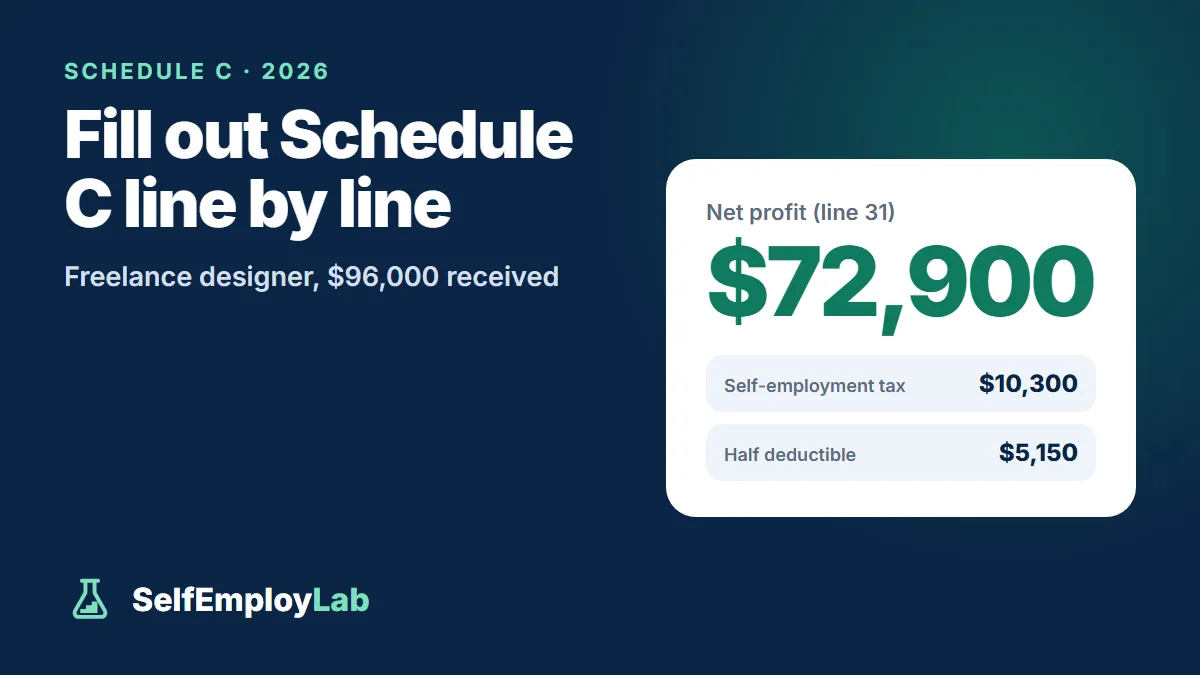
| 31 | Net profit | $73,900 − $1,000 | $72,900 |
The car line is $2,175 plus $2,432 plus $93 of parking.
Net earnings: $72,900 × 92.35% = $67,323.15
SE tax: $67,323.15 × 15.3% = $10,300.44
Deduction for half of SE tax on Schedule 1: $5,150.22
Her net earnings are well under the $184,500 wage base, so the full 15.3% applies.
That is owed on top of income tax. Check your own numbers with the self-employment tax calculator.
Common mistakes
- Reporting only what’s on your 1099s. Income is taxable whether or not anyone sent a form.
- Reporting the 1099-K net of fees. Report the gross and deduct fees and refunds separately.
- Counting one payment twice because it appears on both a 1099-NEC and a 1099-K.
- Deducting 100% of meals. Most business meals are 50%.
- Including commuting miles or applying the wrong half-year mileage rate.
- Putting home office costs on other lines. They belong on line 30.
- Skipping Schedule SE. If net earnings are $400 or more, you owe SE tax even if you owe no income tax.
Frequently asked questions
Do I report the gross or net amount from my Form 1099-K?
Report the gross amount so your return matches the form. The IRS says the gross figure isn't reduced for fees, refunds, shipping or discounts, and you can deduct those. Refunds to customers can go on line 2 and processing fees on line 10.
What mileage rate do I use on Schedule C for 2026?
The IRS raised the 2026 business rate midyear. Use 72.5 cents per mile for business miles driven January 1 through June 30, 2026, and 76 cents for miles driven from July 1 onward. Add business parking and tolls, then enter the total on line 9.
Do I have to answer the 1099 questions on lines I and J?
Yes. Line I asks whether you made payments that required a Form 1099. For payments made in 2026, a 1099-NEC is generally required when you pay a contractor $2,000 or more. If you answer Yes, line J asks whether you filed them.
Can I deduct all of my business meals on Schedule C?
Usually not. In most cases only 50% of a business meal is deductible, so enter half of the cost on line 24b. Certain transportation workers subject to Department of Transportation hours-of-service limits can deduct 80%. Enter only the deductible amount on the form, not the full cost you paid.