Quick answer
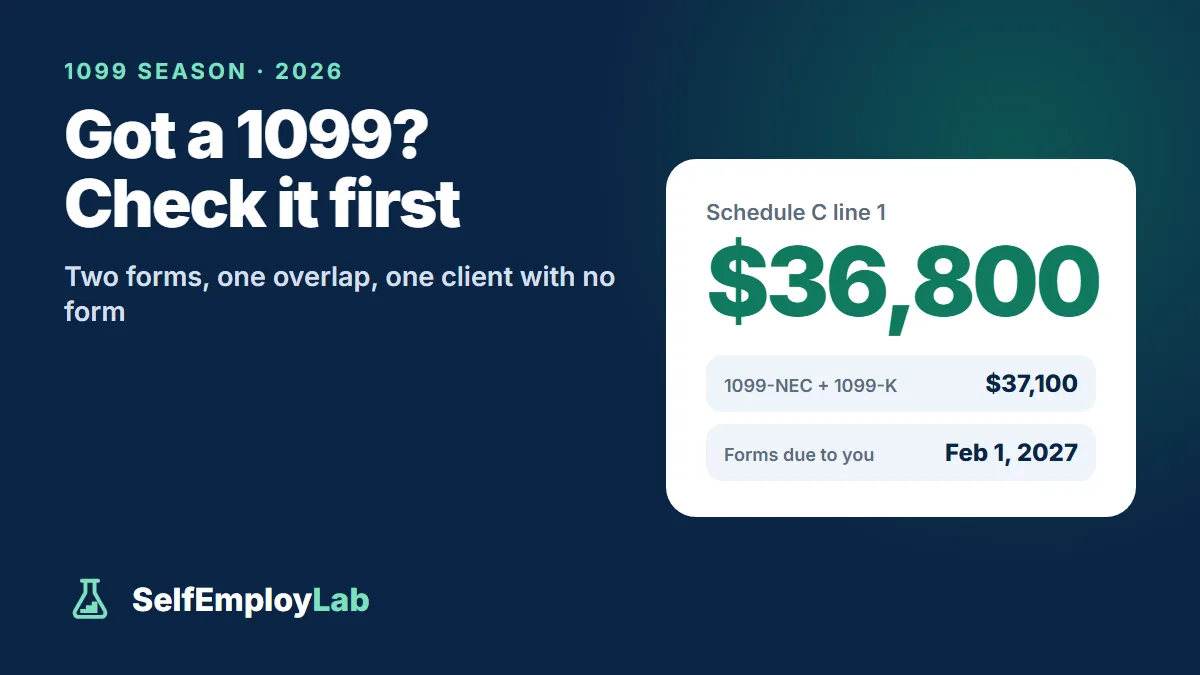
Compare each 1099-NEC and 1099-K with your own records, ask the payer for a corrected form if anything is wrong, and report your true gross receipts once on Schedule C line 1. Income is taxable even with no form. For 2026, forms are due to you by February 1, 2027, because January 31 is a Sunday.
When a 1099-NEC or 1099-K arrives, check it against your own income records, ask the payer to fix anything wrong, and report your actual business income once on Schedule C line 1, whether or not every payer sent a form. The 1099 is the payer’s report to the IRS, not your tax bill, so your records decide what you owe and the forms are what you reconcile against.
When the forms should arrive
For both forms, the deadline for getting your copy to you is January 31. Because January 31, 2027 falls on a Sunday, and IRS rules move any filing or furnishing date that lands on a weekend or legal holiday to the next business day, the practical deadline for 2026 forms is Monday, February 1, 2027.
| Form | Due to you | Due to the IRS |
|---|---|---|
| 1099-NEC | February 1, 2027 | February 1, 2027 (paper or electronic) |
| 1099-K | February 1, 2027 | March 1, 2027 on paper (February 28 is a Sunday), or March 31, 2027 if filed electronically |
Many platforms post the 1099-K in your account instead of mailing it. If a form hasn’t shown up by mid-February, ask the payer. You can still file from your own records without it.
Check every form against your records
Before you enter anything, line each form up with your invoices, platform reports and bank statements. For each one, confirm:
- Your name and taxpayer ID. The last four digits should match the SSN or EIN on your Form W-9.
- The amount. On a 1099-NEC, nonemployee compensation is in box 1a on the December 2026 revision (box 1 on older versions). On a 1099-K, the gross amount is in box 1a.
- What it covers. A 1099-K shows gross payments before fees, refunds and shipping, so it will usually be higher than what landed in your bank. That gap alone is not an error.
- Box 4. If it shows an amount, tax was withheld from your payments. More on that below.
If you aren’t sure why you got one form and not the other, the 1099-NEC vs 1099-K explainer covers who sends each and when.
If a 1099 is wrong
Start with the payer, not the IRS. The IRS can’t correct someone else’s information return. The payer fixes it by issuing a new form with the “CORRECTED” box checked, which goes to both you and the IRS. Put the request in writing, with your records, and keep a copy.
Don’t hold your return waiting for the correction. If the payer won’t fix it, or won’t fix it in time:
- 1099-NEC too high. Report the correct gross receipts on Schedule C line 1. The Schedule C instructions say that if the total in box 1 of your Forms 1099-NEC is more than what you report on line 1, attach a statement explaining the difference. Keep the payment records and your correspondence with the payer.
- 1099-K includes money that isn’t income. Say a friend’s repayment for tickets was tagged as a goods-and-services payment. On the 2025 Form 1040, you entered amounts reported in error in the entry space at the top of Schedule 1, and the rest of the 1099-K went where it belongs, such as Schedule C. The IRS 1099-K FAQs also describe an offsetting pair of entries on Schedule 1 lines 8z and 24z that nets to zero. Check the 2026 instructions for the exact spot when they come out.
- You think you were really an employee. The 1099-NEC instructions say to report it as wages and file Form 8919.
If a corrected form arrives after you file and your return used a different number, file Form 1040-X if needed.
If you never got a 1099
The income is still taxable. The reporting thresholds only control whether a payer has to send a form. For payments made in 2026, a client generally files a 1099-NEC once it pays you $2,000 or more, and a payment app or marketplace files a 1099-K once your gross payments are over $20,000 and you have more than 200 transactions. Card processors report card payments with no minimum, and some states set lower 1099-K thresholds.
A $1,500 client, a few cash jobs, or app sales under the threshold may produce no form at all. All of it still goes on Schedule C line 1. For the bigger picture on reporting small amounts of side income, see the side hustle taxes guide.
The same income on a 1099-NEC and a 1099-K
When a client pays you by credit card or through a payment app, the IRS says that payment belongs on the 1099-K only. The client should leave it off the 1099-NEC. Clients don’t always know that.
Report it once. Ask the client for a corrected 1099-NEC that excludes the app or card payments. If they won’t issue one, report your true gross receipts and keep the invoice, the app record and the client’s 1099-NEC together, so you can show the overlap if the IRS asks. If the inflated 1099-NEC leaves your total in box 1 above your Schedule C line 1 entry, attach the explanatory statement described above.
A 1099-K for personal items sold at a loss
If you sold your own used things for less than you paid, there is no gain and no tax, and the loss isn’t deductible. The 1099-K still reports the sale, so you show why it isn’t income. On the 2025 return, you entered that amount in the same entry space at the top of Schedule 1. In the IRS example, someone who bought a couch for $1,000 and sold it for $700 enters $700. A personal item sold at a gain is different: the gain is taxable and goes on Form 8949 and Schedule D. If you also sell items for profit, those sales belong on Schedule C. The guide to Etsy and eBay seller taxes explains where that line falls.
Box 4: backup withholding
Most freelancers see $0 in box 4. If there is an amount, the payer withheld federal income tax from your payments at the 24% backup withholding rate, usually because it didn’t have a valid taxpayer ID for you. You claim it as federal tax withheld on your Form 1040, on the line for withholding from Forms 1099 (line 25b on the 2025 form), and it reduces your balance due or adds to your refund. To stop it going forward, give the payer a correct, signed Form W-9.
Worked example: two 1099s and a missing one
Jordan is a freelance designer. Here is what Jordan’s own records show for 2026:
- Client A paid $14,000: $12,800 by bank transfer and $1,200 through a payment app.
- Small clients paid $21,000 through the same app. The app kept 3% in fees on Jordan’s $22,200 of business payments, or $666.
- Client B paid $1,800 by bank transfer.
- A friend repaid $900 for concert tickets through the app, and it was tagged as a goods-and-services payment.
In early 2027, two forms arrive. Client A’s 1099-NEC shows $14,000, which wrongly includes the $1,200 paid through the app. The app’s 1099-K shows $23,100 ($21,000 + $1,200 + $900). Client B sends nothing, since $1,800 is under the $2,000 threshold.
| Step | Math | Result |
|---|---|---|
| Total on both forms | $14,000 + $23,100 | $37,100 |
| Remove the duplicate | − $1,200 (on both forms) | $35,900 |
| Remove the non-income payment | − $900 (ticket repayment) | $35,000 |
| Add income with no form | + $1,800 (Client B) | $36,800 |
| Gross receipts, Schedule C line 1 | $36,800 |
Now check that against the bank. Deposits were $12,800 from Client A, $22,434 in app payouts ($23,100 − $666 in fees) and $1,800 from Client B, for a total of $37,034. Add back the $666 in fees and take out the $900 ticket repayment: $37,034 + $666 − $900 = $36,800. The bank and the forms agree.
Where the numbers go
- Schedule C line 1: gross receipts from your records, covering your business 1099s plus income with no form. The Schedule C guide walks through the rest of the form.
- Schedule C expenses: platform fees and other business costs, deducted separately rather than netted out of line 1.
- Schedule SE: self-employment tax on your net profit.
- Form 1040: any box 4 withholding, counted as tax already paid.
Once you know your real profit, the tax set-aside calculator shows how much of each payment to put aside so this year’s bill doesn’t catch you short.
Frequently asked questions
What if my client won't correct a wrong 1099-NEC?
File anyway using the correct amount from your records on Schedule C line 1. If your 1099-NEC box 1 totals are higher than line 1, the Schedule C instructions say to attach a statement explaining the difference. Keep invoices and your correction request.
The same payment is on my 1099-NEC and my 1099-K. Do I pay tax twice?
No. Report it once. The IRS says card and payment-app payments belong only on the 1099-K, so ask the client for a corrected 1099-NEC, and keep the invoice and app record showing the overlap in case the IRS asks.
What does box 4 on a 1099 mean?
Box 4 shows backup withholding, federal income tax the payer took out at 24%, usually because it lacked a valid taxpayer ID for you. Claim it on Form 1040 as tax withheld, and give the payer a correct Form W-9 to stop it.
Do I owe tax on a 1099-K for selling my old furniture?
Not if you sold it for less than you paid. There is no gain, and the loss isn't deductible. On the 2025 return, that amount went in the entry space at the top of Schedule 1. A personal item sold at a gain goes on Form 8949 and Schedule D.