Quick answer
Online sellers who sell to make a profit report sales on Schedule C, subtract cost of goods sold, platform fees and shipping, and pay 15.3% self-employment tax on 92.35% of profit once net earnings hit $400. For 2026, a 1099-K is required above $20,000 and 200 transactions. Personal items sold at a loss aren't taxable or deductible; gains are taxable.
If you sell on Etsy, eBay, Poshmark or your own Shopify store to make money, your profit is taxable business income: you report sales minus cost of goods sold and selling expenses on Schedule C, and pay self-employment tax once net earnings reach $400. Selling your own used belongings is different. A loss on a personal item isn’t deductible and isn’t income, while a gain is taxable.
Business, hobby, or just clearing out the closet?
Online sellers usually fall into one of three groups, and each one is taxed differently:
- Makers and resellers running a business. You make things or buy items to resell, and you’re doing it to earn a profit. Income and expenses go on Schedule C.
- Hobby sellers. You sell now and then without a real profit motive. The income is still taxable, but under current law you can’t deduct the expenses. See hobby vs business income for how the IRS draws the line.
- People selling personal items. You’re selling clothes, furniture or electronics you bought for your own use. This isn’t a business at all.
The personal-item rule
The IRS rule in Publication 525 is lopsided. If you sell something you owned for personal use for more than you paid, the gain is taxable as a capital gain, reported on Form 8949 and Schedule D. If you sell it for less than you paid, which is the usual case with a used jacket or a couch, you can’t deduct the loss. You also don’t owe tax on that money, because there’s no gain.
Flipping is not the same thing. If you buy items at thrift stores or estate sales in order to resell them, those items are inventory, not personal belongings. What you paid for them becomes cost of goods sold, and your profit is business income.
Form 1099-K thresholds for 2026
For 2026, payment apps and online marketplaces must file a Form 1099-K for you when your gross payments are more than $20,000 and you have more than 200 transactions in the year. A 2025 law brought back this older threshold and applied it retroactively, which replaced the lower $600 threshold that had been scheduled.
You may still get a 1099-K below that level:
- The IRS says platforms may send one for smaller amounts.
- Some states set lower reporting thresholds. Etsy says it issues a 1099-K to sellers who meet either the federal threshold or their state’s threshold.
- For payment card transactions, such as card sales processed for your own website, the federal rules set no minimum at all.
The thresholds only decide whether a form gets filed. Your profit is taxable either way. For a comparison with the form clients send, see 1099-NEC vs 1099-K.
Gross receipts vs. what you actually kept
The 1099-K reports gross sales. According to the IRS, the amount isn’t reduced for fees, refunds, shipping, discounts or credits. Etsy says its 1099-K counts the total that buyers paid you, including shipping, before any fees, refunds or shipping costs come out. One exception: Etsy says the sales tax it collects and remits for you is left off the form.
So the number on the form will be higher than your deposits. That’s expected. Report gross receipts from your own records on Schedule C line 1, make sure that total is at least as large as what your 1099-Ks show, and then subtract refunds, fees and other costs in the proper places. Don’t net the fees out before you enter the 1099-K amount, or your return won’t match the form the IRS has on file.
Cost of goods sold for makers and resellers
When you sell products, you figure cost of goods sold (COGS) in Part III of Schedule C. It works like this: beginning inventory, plus purchases, labor, materials and other production costs, minus ending inventory.
- Resellers count what they paid for merchandise, plus freight-in to get it to them.
- Makers count raw materials and supplies used to make the goods, containers and packaging that are part of the product, and wages paid to helpers. Your own time doesn’t count, because you can’t pay yourself a wage on Schedule C.
Inventory affects timing. Under Publication 334, inventory items generally aren’t deducted when you buy them. Their cost reaches COGS when the items are sold, or used up in production. Yarn or vintage stock still on the shelf on December 31 counts as ending inventory, and you deduct it in the year it sells. Small business taxpayers, which covers nearly every online seller, can skip formal inventory accounting. Even then, inventory is treated as materials and supplies, and those are deducted when used or consumed, not when purchased.
Deductible selling costs
Ordinary costs of running the shop are deducted on Schedule C. Common ones for online sellers include:
- Platform fees: listing, transaction, payment processing and subscription fees, plus on-site ads
- Shipping: postage and labels you pay, and supplies like boxes, mailers, tape and tissue that aren’t part of the product
- Materials and supplies not already counted in COGS
- Photography and software: a lightbox, editing apps, bookkeeping software
- Home office: space used regularly and exclusively for the business. The simplified method is $5 per square foot, up to 300 square feet ($1,500).
Don’t count anything twice. A cost that’s already in COGS, like materials, can’t also appear as a supply expense. For more ideas, see freelancer tax deductions.
Sales tax: who collects it
Sales tax is a separate tax that buyers pay, and states handle it, not the IRS. State marketplace facilitator laws generally put the duty to collect on the marketplace instead of on you, at least for sales made through the marketplace.
- Etsy says it calculates, collects and remits US sales tax for sellers in every state with a statewide sales tax, plus DC, Puerto Rico and parts of Alaska. Sellers can’t opt out.
- eBay lists 46 states, DC and Puerto Rico where it collects and remits sales tax for sellers.
- Your own Shopify store is different. Shopify says it doesn’t remit or file taxes for you unless you use Shopify Tax with automated filing. You’re responsible for registering and collecting wherever you owe tax. The same goes for in-person sales, such as at craft fairs.
Even when a marketplace collects the tax, your home state may still want something from you. In Texas, for example, the Comptroller says sellers based in Texas still need a sales tax permit and must file returns even if all their sales go through a marketplace. Check your state revenue department’s marketplace page. Sales tax a marketplace collects and remits isn’t your income.
Self-employment tax and quarterly payments
If your shop is a business, you owe self-employment tax once your net earnings from self-employment are $400 or more. The rate is 15.3% (12.4% Social Security plus 2.9% Medicare), applied to 92.35% of your profit. You can deduct half of it when figuring income tax. Your profit is also subject to regular income tax, on top of any other income you have.
If you expect to owe $1,000 or more when you file, the IRS expects you to pay during the year through quarterly estimated payments, or extra withholding from a day job. The tax set-aside calculator tells you what share of each payout to save.
Worked example: an Etsy maker
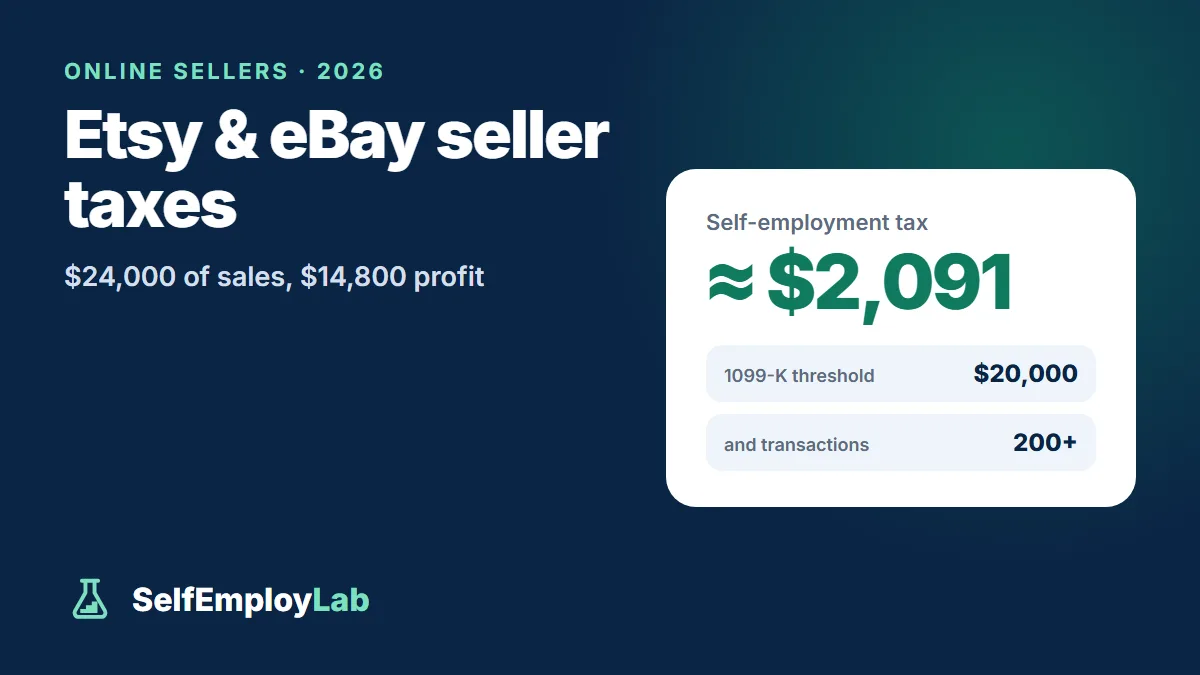
Maya makes ceramic mugs. In 2026 her buyers pay $24,000 across about 600 orders. That’s over both federal thresholds, so she gets a 1099-K showing $24,000.
| Line | Amount |
|---|---|
| Gross receipts (matches 1099-K) | $24,000 |
| Cost of goods sold: clay, glaze, firing costs, product packaging | −$5,000 |
| Gross profit | $19,000 |
| Etsy fees (listing, transaction, processing, ads) | −$3,000 |
| Shipping labels and supplies | −$1,200 |
| Net profit (Schedule C) | $14,800 |
Records that make tax time easy
- Download your platform’s annual sales and fee reports each January.
- Keep receipts for materials and inventory, and note what’s unsold on December 31.
- Keep personal-item sales separate from business sales, with a note of what you originally paid.
- Match your gross receipts against every 1099-K before you file.
Frequently asked questions
Do I pay tax on selling my own used clothes on Poshmark or eBay?
Not if you sell them for less than you paid. A loss on a personal item isn't deductible, and there's no gain to tax. If you sell a personal item for more than you paid, the gain is taxable as a capital gain.
When will Etsy or eBay send me a 1099-K for 2026?
Federally, when your gross payments are over $20,000 and you have more than 200 transactions. Platforms may send one below that, and some states set lower thresholds.
Why is my 1099-K higher than what I was paid out?
The form shows gross sales before fees, refunds and shipping costs. Report gross receipts on Schedule C, then deduct those costs and your cost of goods sold.
Do I have to collect sales tax on Etsy and eBay sales?
Generally not for marketplace orders. Etsy and eBay collect and remit sales tax in nearly every state that has one. Your own website and in-person sales are your responsibility, and your home state may still require a permit or returns.