Quick answer
If you are self-employed and use part of your home regularly and exclusively as your principal place of business, you can deduct it on Schedule C for 2026. The simplified method allows $5 per square foot up to 300 square feet, a $1,500 maximum. The regular method on Form 8829 deducts your business percentage of actual home costs.
Yes, if you are self-employed and use part of your home regularly and exclusively as your main place of business, you can deduct a home office on your 2026 Schedule C. The simplified method gives you $5 per square foot, up to 300 square feet, for a maximum of $1,500, while the regular method on Form 8829 deducts the business share of your actual home costs and is often worth more.
Which method wins depends on your home costs and the size of your office. A worked example at the end compares both.
Who qualifies
The deduction is for people who report business income on Schedule C: freelancers, independent contractors and sole proprietors. You can rent or own.
Regular and exclusive use
The space must be used only for business. Publication 587 is direct about it: if you use the area for both business and personal purposes, you don’t meet the exclusive use test. A guest room with a desk fails. A spare room used only for client work passes.
The space doesn’t have to be a whole room. It can be a separately identifiable area, and it doesn’t need a permanent wall around it. It also has to be used regularly. Occasional or incidental business use doesn’t count.
Principal place of business
The office must also be your principal place of business. For most freelancers, that is the easy part, because the home office is where the work happens. If you also work at client sites, the administrative and management rule helps. Your home office qualifies if you use it regularly and exclusively for administrative or management work, such as billing, bookkeeping, scheduling and ordering supplies, and you have no other fixed location where you do substantial amounts of that work.
Doing some paperwork in a hotel room or your car doesn’t disqualify you. A space where you regularly meet clients, or a detached studio used for business, can also qualify.
Two exceptions to exclusive use
- Daycare. If you provide daycare for children, people 65 or older, or people who can’t care for themselves, and you are licensed or exempt from licensing under state law, regular use is enough. The space can double as family space after hours.
- Storage. If you sell products and your home is the only fixed location of the business, a separately identifiable space used regularly to store inventory or product samples qualifies without the exclusive use test.
W-2 employees can’t take it
Employees who work from home get no federal home office deduction. The Tax Cuts and Jobs Act suspended miscellaneous itemized deductions, including unreimbursed employee expenses, starting in 2018. The 2025 law known as the One Big Beautiful Bill Act made that disallowance permanent, as IRS Notice 2026-10 confirms. A day job doesn’t block a home office for your side business, if that office meets the tests.
The simplified method
Multiply the square footage of your office by $5. The area is capped at 300 square feet, so the most you can deduct is $1,500. The deduction goes straight on Schedule C, line 30, with no Form 8829.
- No depreciation, so nothing to recapture when you sell.
- If you own and itemize, you still deduct all of your mortgage interest and property tax on Schedule A, not split with the business.
- The deduction can’t exceed your business’s gross income minus your other business expenses, and any excess is lost. It doesn’t carry over.
- You can’t use carryovers from a prior regular-method year while you use the simplified method.
You choose the method each year on a timely filed return. That year’s choice can’t be changed later, but you can switch the following year.
The regular method (Form 8829)
The regular method deducts the business share of what your home actually costs. Start with your business-use percentage: office square feet divided by the home’s total square feet. A 200-square-foot office in a 1,600-square-foot home is 12.5%.
Apply that percentage to indirect expenses, the ones that cover the whole home:
- Rent, if you rent
- Mortgage interest and real estate taxes, if you own
- Homeowners or renters insurance
- Utilities such as electricity, gas, water and trash
- General repairs and maintenance
- Depreciation on the building, if you own
Direct expenses, such as painting or repairing only the office, are deductible in full. Expenses only for personal parts of the home, like landscaping or a kitchen remodel, aren’t deductible at all.
Depreciation for owners
Owners depreciate the business part of the house as nonresidential real property over 39 years, straight line. The basis is the business percentage times the smaller of your adjusted basis or the home’s fair market value when business use began, with the land taken out, because land isn’t depreciable. In a full year, the deduction is 2.564% of that basis. The first year is smaller and depends on the month you started. Under the 2025 table, it runs from 2.461% for January to 0.107% for December.
Renters vs owners
Renters deduct the business percentage of rent, renters insurance and utilities, with no depreciation and no recapture. Since rent is a large expense, the regular method often wins easily for renters. Owners add depreciation but take on the recapture rule below.
The gross income limit and carryovers
Under either method, the home office deduction can’t create or increase a business loss. Form 8829 applies the limit in a set order:
- Start with your business’s gross income, minus business expenses that have nothing to do with the home, such as software, supplies and a business phone.
- Subtract the business share of mortgage interest, real estate taxes and qualified disaster losses you could deduct anyway.
- What’s left caps your operating expenses: rent, insurance, utilities and repairs.
- Depreciation comes last.
Under the regular method, operating expenses and depreciation that don’t fit carry forward to the next year you use the regular method, even if you’ve moved. Under the simplified method, the excess is gone. That makes the regular method worth a look in a low-income first year.
Selling your home: depreciation recapture
If your office is inside your home, you don’t have to split the sale into a business part and a personal part. The usual exclusion of up to $250,000 of gain ($500,000 married filing jointly) still applies, if you meet the ownership and use tests. There is one carve-out: you can’t exclude the part of your gain equal to depreciation allowed or allowable after May 6, 1997. That portion is unrecaptured section 1250 gain, taxed at a maximum rate of 25%.
“Allowable” means skipping depreciation under the regular method doesn’t help: it still counts at sale. Simplified-method years carry no depreciation, so nothing is recaptured for them.
A separate structure, like a detached studio, is different: unless it meets the two-year use test, you split the gain and report the business part on Form 4797.
Worked example: simplified vs regular
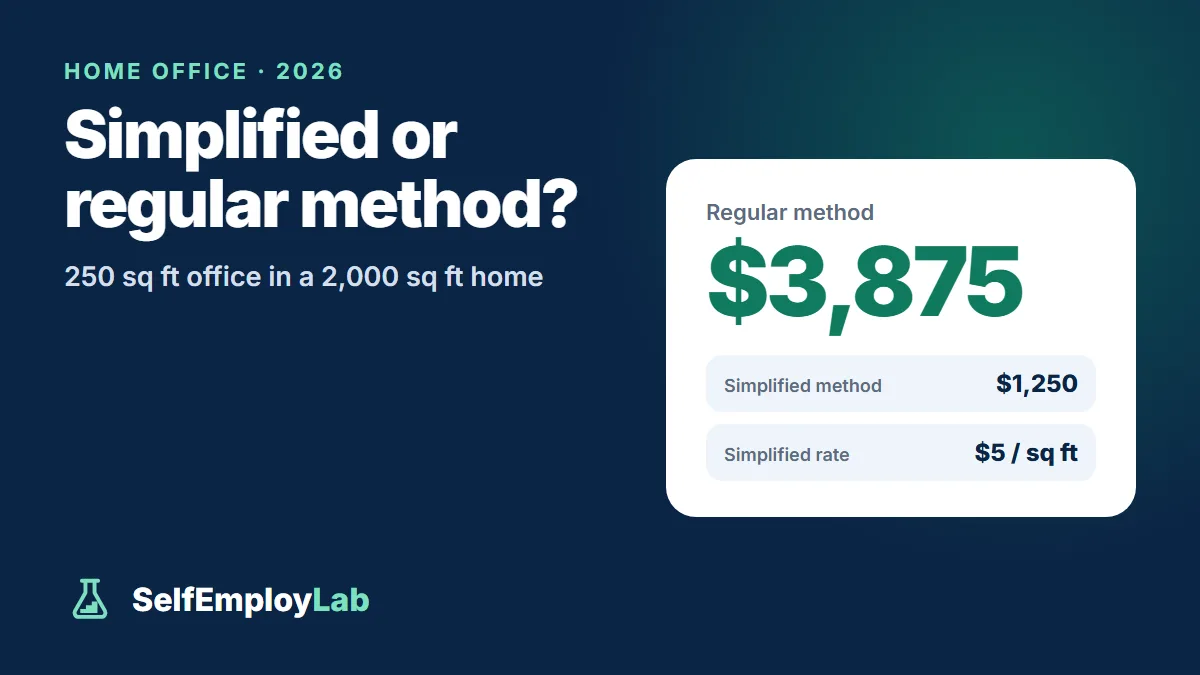
Maya is a freelance designer. She owns a 2,000-square-foot house and works in a 250-square-foot spare room used only for her business. She began using it in 2024, so 2026 is a full year of depreciation. She takes the standard deduction, and her business profit easily covers the deduction.
Business-use percentage: 250 ÷ 2,000 = 12.5%. She bought the house for $400,000, of which $80,000 was land. Its value when business use began was higher, so she uses her basis: $400,000 − $80,000 = $320,000 for the building.
| Item | Math | Business share |
|---|---|---|
| Mortgage interest | $12,000 × 12.5% | $1,500.00 |
| Real estate taxes | $4,800 × 12.5% | $600.00 |
| Homeowners insurance | $1,600 × 12.5% | $200.00 |
| Utilities | $3,600 × 12.5% | $450.00 |
| General repairs | $800 × 12.5% | $100.00 |
| Depreciation | $320,000 × 12.5% = $40,000; × 2.564% | $1,025.60 |
| Regular method total | $3,875.60 | |
| Simplified method | 250 sq ft × $5 | $1,250.00 |
The regular method deducts $3,875.60 − $1,250.00 = $2,625.60 more. Because she takes the standard deduction, her mortgage interest and property tax do nothing for her under the simplified method. Under the regular method, the business share of both moves onto Schedule C.
A Schedule C deduction lowers both of her taxes. In the 22% bracket, the extra $2,625.60 saves:
- Self-employment tax: $2,625.60 × 92.35% × 15.3% = $370.99
- Income tax: ($2,625.60 − $185.50 for half the SE tax) × 22% = $2,440.10 × 22% = $536.82
- Total: about $908 a year, before the qualified business income deduction, which would trim the income tax part somewhat
The trade-off is recapture. If she sells after five full years of $1,025.60 depreciation, about $5,128 of her gain is taxable at up to 25%, even if the rest of the gain is excluded. That is at most about $1,282 of tax, against roughly $4,540 saved over those five years at the rate above. If she rented instead, at $2,000 a month, her regular-method deduction would include $24,000 × 12.5% = $3,000 of rent alone, with no recapture to worry about.
Records to keep
Keep measurements and photos of the space, plus bills and receipts for every expense you allocate. Owners should keep purchase records and each year’s depreciation figure until the return for the year of sale can no longer be audited.
The home office is one deduction among many. See our list of freelancer tax deductions for the rest, and self-employment tax vs income tax for why a Schedule C deduction saves you more than an itemized one.
Frequently asked questions
Can I take the home office deduction if I rent my apartment?
Yes. Renters qualify under the same use tests as owners. Under the regular method you deduct your business percentage of rent, renters insurance and utilities on Form 8829. Renters have no depreciation, so there is nothing to recapture if you move out.
Can I deduct a home office as a W-2 employee working remotely?
No. Unreimbursed employee expenses, including a home office, have not been deductible since 2018, and the One Big Beautiful Bill Act made that disallowance permanent. If you also run a side business, a home office used for that business can still qualify.
What happens if my home office deduction is more than my business income?
The deduction can't create a business loss. Under the regular method, the excess operating expenses and depreciation carry forward to the next year you use the regular method. Under the simplified method, anything above the income limit is lost and doesn't carry over.
Do I owe tax on home office depreciation when I sell my house?
Usually, yes. Depreciation allowed or allowable after May 6, 1997 can't be excluded from your gain, even when the rest qualifies for the $250,000 or $500,000 exclusion. That portion is unrecaptured section 1250 gain, taxed at a maximum rate of 25%.