Quick answer
Rideshare and delivery drivers are independent contractors, so they report earnings and expenses on Schedule C and pay 15.3% self-employment tax on 92.35% of profit. For 2026, deduct 72.5¢ per business mile through June 30 and 76¢ from July 1. Report 1099-K gross, then deduct platform fees. Miles from home to the first pickup can be commuting.
If you drive for Uber, Lyft, DoorDash, Instacart or Uber Eats, you are generally taxed as a self-employed business owner: you report your earnings and expenses on Schedule C and pay self-employment tax on the profit with Schedule SE. Your biggest lever is the vehicle deduction, which for 2026 means two business mileage rates, 72.5¢ per mile through June 30 and 76¢ per mile from July 1.
Drivers are independent contractors
The major apps treat US drivers and couriers as independent contractors, not employees. Nothing is withheld from your payouts. The IRS lists “drive a car for booked rides or deliveries” as gig work and says independent contractors file Form 1040 with:
- Schedule C: your gross earnings, minus business expenses, equals your profit.
- Schedule SE: self-employment tax on that profit, once your net earnings from self-employment reach $400 for the year.
If a platform gives you a W-2 instead, as some in-store shopping jobs do, that work is employment and these rules don’t apply to it.
Which 1099 forms you will get
For 2026 payments, the federal reporting thresholds are:
| Form | What it usually covers for drivers | Federal threshold (2026) |
|---|---|---|
| 1099-K | Payments processed through the app, such as ride fares | Over $20,000 and over 200 transactions |
| 1099-NEC | Payments the platform makes to you directly for services, such as delivery pay, referral bonuses or promotions | $2,000 or more |
How each platform uses these forms is its own choice. Uber says drivers and couriers may receive a 1099-K, a 1099-NEC and/or a 1099-MISC. Lyft says it issues a 1099-K for ride payments and a 1099-NEC for non-driving income such as referral and streak bonuses. DoorDash’s tax form partner, Stripe, says Dashers receive a 1099-NEC if they earn $2,000 or more in 2026. Instacart shoppers get their forms through the Shopper app.
The thresholds tell the platform when it must file. The IRS says you may still receive a 1099-K below them, and some states set lower thresholds. Either way, income is taxable whether or not a form arrives. For more on how the two forms differ, see 1099-NEC vs 1099-K.
Gross vs. net: the 1099-K trap
For a rideshare driver, the 1099-K usually shows the total the riders paid, not what landed in your bank account. The IRS says the gross amount on a 1099-K “doesn’t include adjustments for fees, credits, refunds, shipping, cash equivalents or discounts.” Your deposits are smaller because the platform’s service fee and other charges were taken out first.
The fix is simple: report the gross amount as income, then deduct the platform’s fees and commissions as a business expense. Uber’s tax summary breaks those amounts down. What you must not do is report your net deposits and also deduct the fees, because that counts the fees twice. If your forms show only your earnings and no fees, there is nothing extra to deduct.
Standard mileage rate or actual expenses
You can deduct your car one of two ways:
- Standard mileage rate: 72.5¢ per business mile driven January 1 through June 30, 2026, and 76¢ per mile from July 1 (the IRS raised the rate mid-year because fuel prices went up). Business parking and tolls are deductible on top.
- Actual expenses: the business share of gas, insurance, repairs, tires, registration, and depreciation or lease payments, based on business miles divided by total miles.
For a car you own, the IRS says you must choose it in the first year the car is available for use in your business; after that you can switch between methods. For a leased car, if you use the standard rate you must keep using it for the whole lease. Because the rate changed mid-year, your log needs dates. Full details are in the 2026 mileage deduction guide.
Which miles count
This is where drivers most often go wrong, and the IRS has not written a rule just for app drivers. The general rules in Publication 463 and the Schedule C instructions apply:
- Miles between business stops count. Driving from a pickup to a drop-off, and from one customer to the next, is business driving.
- The first and last legs may be commuting. In Publication 463, the IRS says that if you have no regular office and no office in your home, the location of your first business contact in your metro area is considered your office. Driving from home to that first contact, and from your last contact back home, is nondeductible commuting.
- A home office can change that. If your home is your principal place of business (it meets the home office rules), the IRS treats trips between home and another work location in the same business as deductible business travel.
- Errands for the business count, such as a trip to pick up supplies.
The IRS doesn’t specifically address miles driven with the app on while you wait for a request. If you claim them, keep a clean log of when you were logged in and driving, and know the position is less settled than miles driven with a passenger or order.
Other deductions drivers can claim
- Your phone: the business-use share of the device and monthly plan.
- Tolls and parking while working (not parking at a regular workplace, which the IRS treats as commuting).
- Delivery gear: insulated bags, phone mounts, chargers and similar supplies.
- Platform fees and commissions, if they are included in the gross amount you reported.
If you use the standard mileage rate, don’t also deduct gas, insurance or repairs; the rate already covers them. More ideas are in side hustle taxes.
Tips: taxi and rideshare drivers and goods delivery people are on the IRS list of occupations that customarily receive tips. For 2025 through 2028, qualified tips may be deductible for income tax, up to $25,000 a year, limited to your net income from the business, and phased out above $150,000 of modified AGI ($300,000 joint). It is an income tax deduction only. Tips stay in your Schedule C income, so it does not lower your self-employment tax.
Worked example: ,000 gross, 18,000 miles
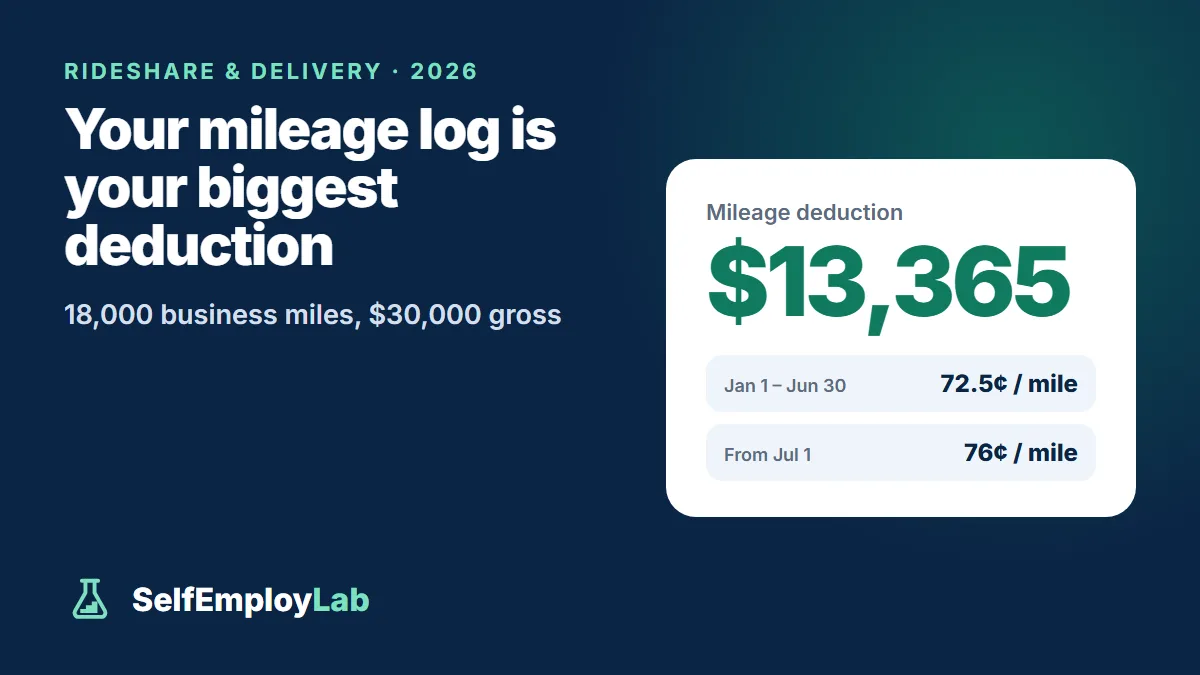
Mileage: 9,000 × $0.725 = $6,525; 9,000 × $0.76 = $6,840. Total: $13,365
Other expenses: phone (60% business) $720 + tolls and parking $300 + supplies $80 = $1,100
Gross income: $30,000
− Platform fees: $6,000
− Mileage: $13,365
− Other expenses: $1,100
Schedule C profit: $9,535
Self-employment tax: $9,535 × 92.35% = $8,805.57; × 15.3% = $1,347. Half of it ($674) is deductible for income tax.
The mileage log is what makes this example work. Without the $13,365 mileage deduction, profit would be $22,900 and self-employment tax would be about $3,236, so the log saves roughly $1,890 in self-employment tax alone, before any income tax savings.
If this driver is single with no other income, the $16,100 standard deduction for 2026 covers the remaining profit, so they owe no federal income tax, but they still owe the $1,347 of self-employment tax. If the driver also has a day job, the $9,535 profit is added on top of their wages and taxed at their bracket. Check your own numbers with the self-employment tax calculator.
Quarterly estimated taxes
Because nothing is withheld, the IRS expects you to pay during the year if you will owe $1,000 or more when you file. For 2026, estimated payments are due April 15, June 15 and September 15, 2026, and January 15, 2027. If you also have a W-2 job, raising your withholding on Form W-4 can cover your driving income instead. The quarterly estimated tax calculator sizes the payments.
The QBI deduction
Driving profit is generally qualified business income, so you may be able to deduct up to 20% of it when you figure income tax. In the example, qualified business income is $9,535 − $674 = $8,861. But the deduction is also capped at 20% of taxable income before the deduction, and that driver has none, so they get nothing from it. A driver with other income could deduct up to about $1,772. Like the tips deduction, QBI lowers income tax only, not self-employment tax.
Frequently asked questions
Do I owe taxes if Uber or DoorDash didn't send me a 1099?
Yes. The 1099 thresholds only decide whether the platform must file a form. All of your driving income is taxable and belongs on Schedule C, whether or not a form arrives.
Why is my 1099-K higher than what I was paid?
A 1099-K shows gross payments without adjustments for fees. Report the gross amount, then deduct the platform's service fees and commissions as a business expense so you are taxed only on what you actually earned.
Can I deduct the drive from home to my first pickup?
Often not. IRS Publication 463 says that without a regular office or a qualifying home office, your first business contact is treated as your office, so the drive there and the drive home from your last stop are commuting.
What mileage rate do drivers use for 2026?
72.5 cents per business mile for driving from January 1 through June 30, 2026, and 76 cents per mile from July 1 through December 31. Business tolls and parking are deductible on top.