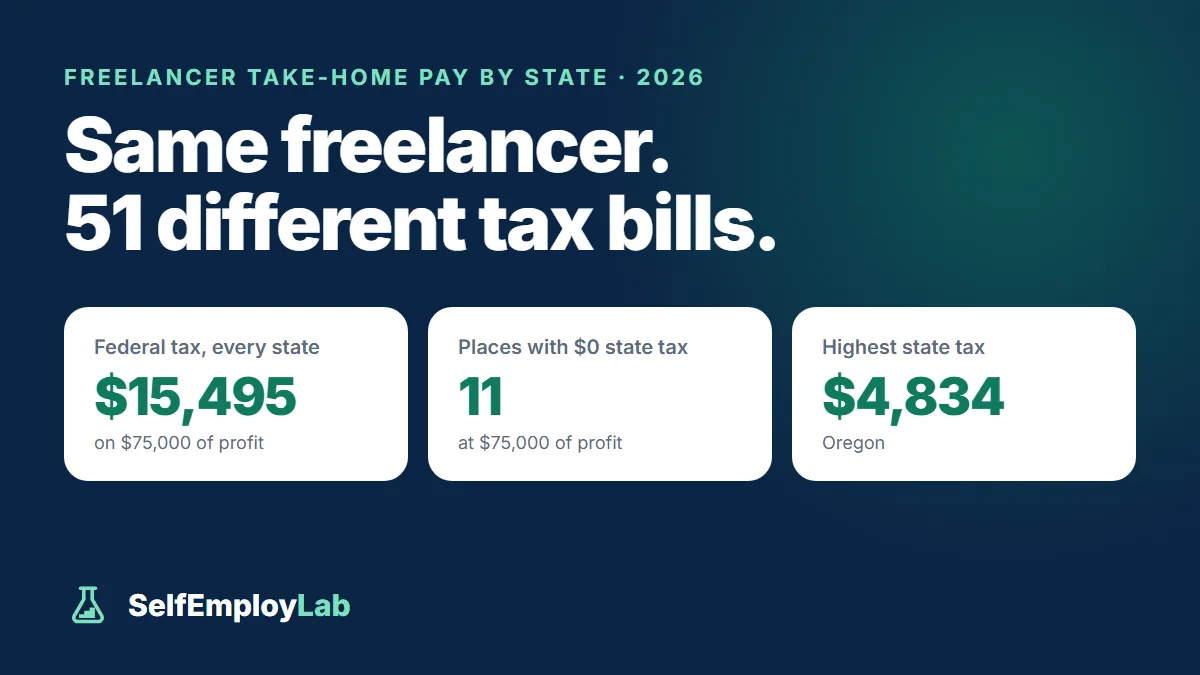
Where you live changes what a freelancer keeps, but by less than most people think. We ran the same three freelancers through the 2026 tax law of all 50 states and Washington, D.C.: a single filer with $50,000, $75,000 or $100,000 of net self-employment profit and no other income. Federal tax is the same everywhere. The state layer is what moves.
Key findings
- The gap between the cheapest and most expensive state is $3,000 to $6,600 a year. At $75,000 of profit, a freelancer in a no-income-tax state keeps $59,505; the same freelancer in Oregon keeps $54,671, a difference of $4,834 (about $400 a month).
- Self-employment tax is bigger than state income tax in every state. At $75,000 of profit, federal self-employment tax is $10,597. The highest state income tax at that level is $4,834.
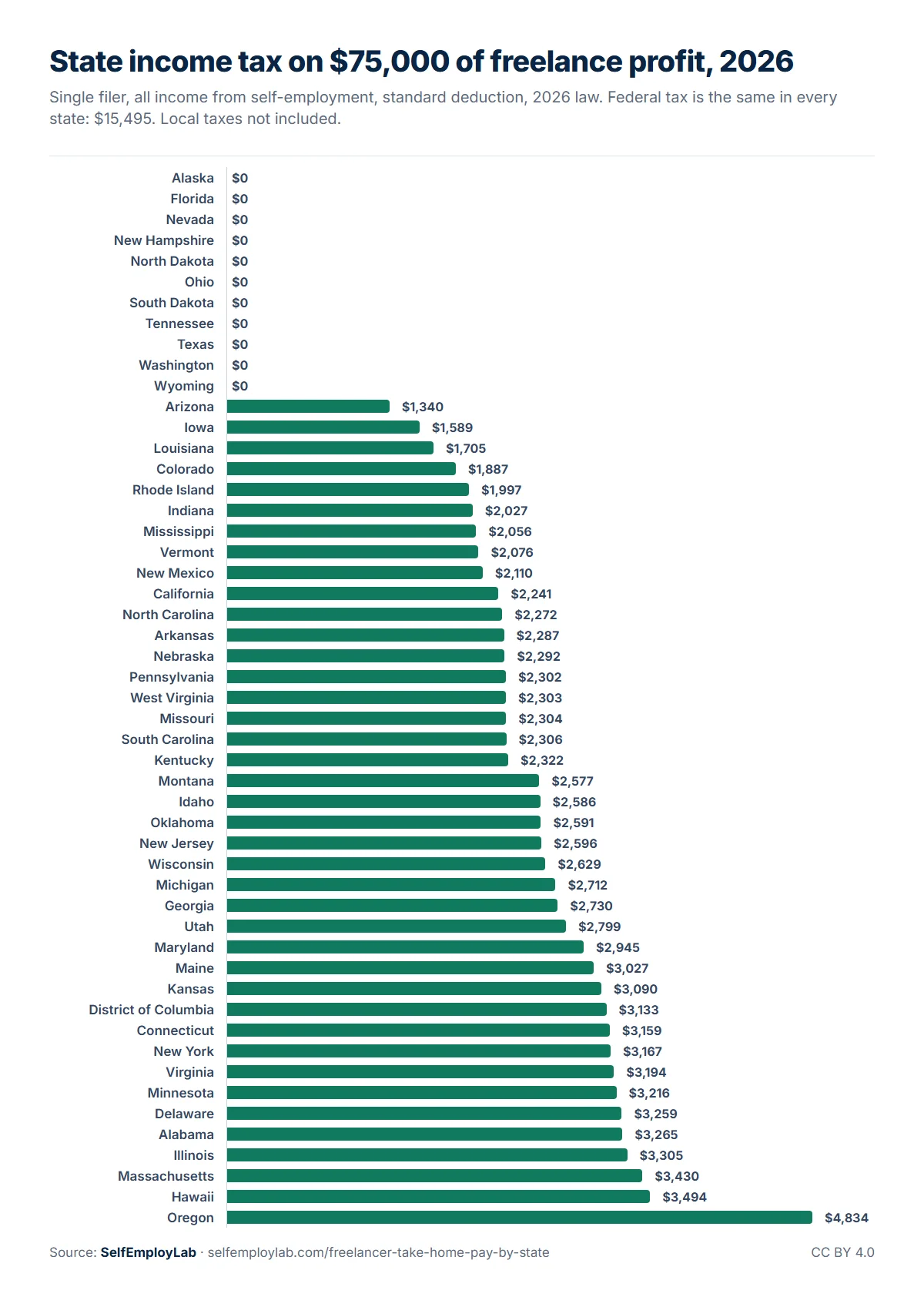
- Eleven places charge this freelancer no state income tax at $50,000 and $75,000. The nine states without a wage or business income tax, plus Ohio (whose business income deduction exempts the first $250,000 of business profit) and North Dakota (whose 0% bracket covers this freelancer up to about $84,000 of profit).
- Oregon has the highest state income tax at every level we tested: $2,996, $4,834 and $6,575.
- California is cheaper than its reputation at lower incomes. At $50,000 of profit, California’s tax is $807, less than Illinois ($2,155), Alabama ($2,127) or New York ($1,912). Its higher brackets catch up by $100,000.
- Several states changed their 2026 law mid-year, retroactive to January 1: Georgia, Arkansas, South Carolina, West Virginia, Utah, Maine and Arizona. Rate tables published at the start of the year are already out of date for them.
The full ranking
Choose a profit level. States are ranked by take-home pay after federal self-employment tax, federal income tax and state income tax. At $50,000 and $75,000 the top eleven tie: the nine no-income-tax states, Ohio and North Dakota all charge $0 of state income tax.
| # | State | State income tax | Total tax | Take-home | Total rate |
|---|---|---|---|---|---|
| 1 | Alaska | $0 | $15,495 | $59,505 | 20.7% |
| 2 | Florida | $0 | $15,495 | $59,505 | 20.7% |
| 3 | Nevada | $0 | $15,495 | $59,505 | 20.7% |
| 4 | New Hampshire | $0 | $15,495 | $59,505 | 20.7% |
| 5 | North Dakota | $0 | $15,495 | $59,505 | 20.7% |
| 6 | Ohio * | $0 | $15,495 | $59,505 | 20.7% |
| 7 | South Dakota | $0 | $15,495 | $59,505 | 20.7% |
| 8 | Tennessee | $0 | $15,495 | $59,505 | 20.7% |
| 9 | Texas | $0 | $15,495 | $59,505 | 20.7% |
| 10 | Washington * | $0 | $15,495 | $59,505 | 20.7% |
| 11 | Wyoming | $0 | $15,495 | $59,505 | 20.7% |
| 12 | Arizona | $1,340 | $16,835 | $58,165 | 22.4% |
| 13 | Iowa * | $1,589 | $17,084 | $57,916 | 22.8% |
| 14 | Louisiana | $1,705 | $17,200 | $57,800 | 22.9% |
| 15 | Colorado * | $1,887 | $17,382 | $57,618 | 23.2% |
| 16 | Rhode Island | $1,997 | $17,492 | $57,508 | 23.3% |
| 17 | Indiana * | $2,027 | $17,522 | $57,478 | 23.4% |
| 18 | Mississippi | $2,056 | $17,551 | $57,449 | 23.4% |
| 19 | Vermont * | $2,076 | $17,571 | $57,429 | 23.4% |
| 20 | New Mexico | $2,110 | $17,605 | $57,395 | 23.5% |
| 21 | California | $2,241 | $17,736 | $57,264 | 23.6% |
| 22 | North Carolina | $2,272 | $17,767 | $57,233 | 23.7% |
| 23 | Arkansas | $2,287 | $17,782 | $57,218 | 23.7% |
| 24 | Nebraska | $2,292 | $17,787 | $57,213 | 23.7% |
| 25 | Pennsylvania * | $2,302 | $17,797 | $57,203 | 23.7% |
| 26 | West Virginia | $2,303 | $17,798 | $57,202 | 23.7% |
| 27 | Missouri * | $2,304 | $17,799 | $57,201 | 23.7% |
| 28 | South Carolina | $2,306 | $17,801 | $57,199 | 23.7% |
| 29 | Kentucky * | $2,322 | $17,817 | $57,183 | 23.8% |
| 30 | Montana | $2,577 | $18,072 | $56,928 | 24.1% |
| 31 | Idaho | $2,586 | $18,081 | $56,919 | 24.1% |
| 32 | Oklahoma | $2,591 | $18,086 | $56,914 | 24.1% |
| 33 | New Jersey | $2,596 | $18,091 | $56,909 | 24.1% |
| 34 | Wisconsin | $2,629 | $18,124 | $56,876 | 24.2% |
| 35 | Michigan * | $2,712 | $18,207 | $56,793 | 24.3% |
| 36 | Georgia | $2,730 | $18,225 | $56,775 | 24.3% |
| 37 | Utah | $2,799 | $18,294 | $56,706 | 24.4% |
| 38 | Maryland * | $2,945 | $18,440 | $56,560 | 24.6% |
| 39 | Maine | $3,027 | $18,522 | $56,478 | 24.7% |
| 40 | Kansas | $3,090 | $18,585 | $56,415 | 24.8% |
| 41 | District of Columbia * | $3,133 | $18,628 | $56,372 | 24.8% |
| 42 | Connecticut | $3,159 | $18,654 | $56,346 | 24.9% |
| 43 | New York * | $3,167 | $18,662 | $56,338 | 24.9% |
| 44 | Virginia | $3,194 | $18,689 | $56,311 | 24.9% |
| 45 | Minnesota | $3,216 | $18,711 | $56,289 | 24.9% |
| 46 | Delaware * | $3,259 | $18,754 | $56,246 | 25.0% |
| 47 | Alabama * | $3,265 | $18,760 | $56,240 | 25.0% |
| 48 | Illinois | $3,305 | $18,800 | $56,200 | 25.1% |
| 49 | Massachusetts | $3,430 | $18,925 | $56,075 | 25.2% |
| 50 | Hawaii | $3,494 | $18,989 | $56,011 | 25.3% |
| 51 | Oregon * | $4,834 | $20,329 | $54,671 | 27.1% |
What the numbers include
Every figure is for tax year 2026 and assumes:
- A single filer, under 65, no dependents, full-year resident, taking the standard deduction.
- All income is net profit from a sole proprietorship or single-member LLC (Schedule C). No W-2 wages, investment income or retirement contributions.
- Federal tax: self-employment tax (15.3% on 92.35% of profit, with the $184,500 Social Security wage base), then income tax after the deduction for half of SE tax, the $16,100 standard deduction and the 20% qualified business income (QBI) deduction.
- State tax: each state’s own starting point, deductions, exemptions, brackets and personal credits as written in 2026 law, including mid-year changes. Where a state does not allow the deduction for half of SE tax (Alabama, Arkansas, New Jersey, Pennsylvania) or adds back the QBI deduction (Montana, and South Carolina from 2026), we followed the state rule. Alabama’s and Missouri’s deductions for federal income tax and Oregon’s federal tax subtraction are included.
What the numbers leave out
- Local income taxes. They matter a lot in a few places: Maryland’s county tax (2.25% to 3.30%, in every county), New York City’s income tax and Unincorporated Business Tax, Pennsylvania’s local earned income tax, Ohio city taxes, Indiana county taxes, and occupational taxes in Kentucky and some Alabama, Michigan and Missouri cities. States with a common local tax, or with an estimated figure, carry an asterisk in the table; hover or tap it for the note.
- Refundable and situational credits, such as renter’s credits, grocery credits and earned income credits, which depend on circumstances beyond profit.
- Other taxes on business: sales tax, gross receipts taxes, LLC fees, property tax.
- Itemized deductions, retirement contributions and health insurance deductions, all of which would lower both federal and state tax.
Two figures are estimates because the state has not published them yet: the District of Columbia’s 2026 standard deduction, and Vermont’s 2026 bracket thresholds and deduction amounts. We will update both when the official numbers come out.
How we checked the figures
We started from the Tax Foundation’s 2026 state rate table, then verified every state’s parameters against its revenue department’s 2026 forms, instructions or withholding formulas and against enacted 2026 legislation. That check changed the inputs for more than a dozen states, mostly because of laws passed after January 1, 2026. Each state’s tax was then computed twice, independently, and the two results were compared; they agree to within $2 for every state. Our federal calculation is the same engine that runs the self-employment tax calculator.
State sources
The main primary source used for each state with an income tax:
- Alabama: Department of Revenue, Form 40 instructions
- Arizona: Laws 2026, chapter 140
- Arkansas: DFA 2026 withholding formula
- California: Franchise Tax Board, Tax News
- Colorado: Colorado General Assembly, HB25B-1001
- Connecticut: DRS tax calculation schedule
- Delaware: Division of Revenue, 2026 estimated tax instructions
- District of Columbia: Office of Tax and Revenue, 2026 D-40ES
- Georgia: Department of Revenue, 2026 employer’s tax guide
- Hawaii: Department of Taxation announcement
- Idaho: State Tax Commission rate schedule
- Illinois: Department of Revenue
- Indiana: Department of Revenue rates
- Iowa: Department of Revenue, 2026 rates
- Kansas: Department of Revenue Notice 25-06
- Kentucky: Department of Revenue, 2026 withholding formula
- Louisiana: Department of Revenue, 2026 withholding tables
- Maine: Maine Revenue Services, 2026 rate schedule (revised)
- Maryland: Comptroller, 2026 withholding guide
- Massachusetts: Department of Revenue tax rates
- Michigan: Treasury, 2026 withholding guide
- Minnesota: Department of Revenue, 2026 brackets
- Mississippi: Department of Revenue
- Missouri: Department of Revenue, 2026 withholding tables
- Montana: Department of Revenue
- Nebraska: Department of Revenue, 2026 tax calculation schedule
- New Jersey: Division of Taxation rate schedules
- New Mexico: Legislature fiscal impact report
- New York: Department of Taxation and Finance tax tables
- North Carolina: Department of Revenue
- North Dakota: Office of State Tax Commissioner, 2026 Form ND-1ES
- Ohio: Department of Taxation, business income deduction
- Oklahoma: Tax Commission, 2026 withholding tables
- Oregon: Department of Revenue, 2026 withholding formulas
- Pennsylvania: Department of Revenue
- Rhode Island: Division of Taxation advisory 2026-02
- South Carolina: Department of Revenue Information Letter #26-20
- Utah: 2026 SB 60 (enrolled)
- Vermont: Department of Taxes
- Virginia: Department of Taxation legislative summary
- West Virginia: Tax Division, 2026 income tax rate cut
- Wisconsin: Department of Revenue, 2026 Form 1-ES instructions
No-income-tax states (Alaska, Florida, Nevada, New Hampshire, South Dakota, Tennessee, Texas, Washington, Wyoming): Tax Foundation, State Individual Income Tax Rates and Brackets, 2026, and Washington DOR on the B&O tax.
Using this data
You’re welcome to quote, chart or republish these figures. Please credit “SelfEmployLab” and link to this page. The full dataset is in the CSV linked under the table. For questions or a different scenario (married filing jointly, other income levels), get in touch.
Run your own numbers
Your profit, deductions and city will differ from these examples. The tax set-aside calculator turns your state rate into one percentage to save from every payment, and the quarterly estimated tax calculator splits the federal part into the four 2026 due dates. Our state guides cover estimated payments and local taxes in more detail.
These figures are estimates for a simplified example and are not tax, legal or financial advice. Check your own situation with a CPA or enrolled agent.