Quick answer
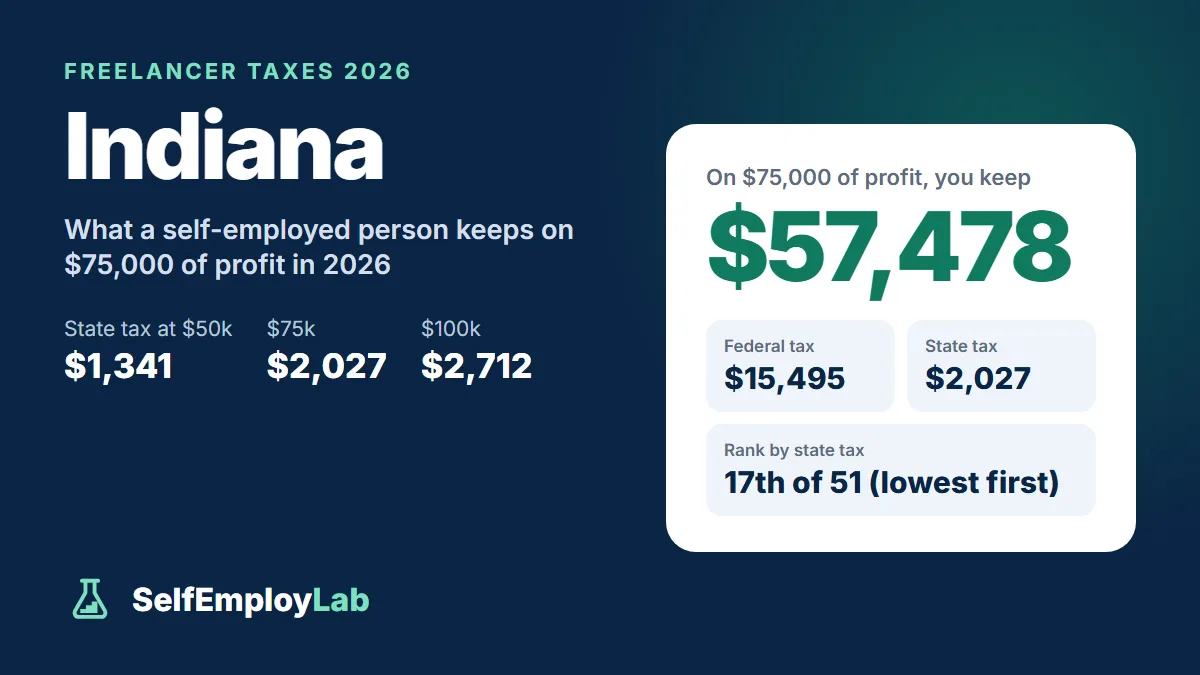
A single freelancer in Indiana with $75,000 of profit pays about $2,027 of Indiana income tax in 2026 on top of about $15,495 of federal tax (self-employment tax of 15.3% on 92.35% of profit plus income tax), keeping about $57,478. At $50,000 the state bill is about $1,341; at $100,000, about $2,712. Every county adds an income tax of 0.5%–3.0%, not included.
Indiana’s state income tax is low and flat: 2.95% for 2026. But every Indiana county adds its own income tax, so a freelancer’s real Indiana rate is usually closer to 4% to 5%. Here is what an Indiana freelancer owes and how to plan for it.
How Indiana compares: in our 50-state take-home pay ranking, a single freelancer with $75,000 of profit keeps $57,478 in Indiana after federal and state income tax (before any local tax), 17th of 51 (state income tax: $2,027).
Set aside from every payment
—
That is $0 of every $1,000 you receive
- Federal income tax share
- —
- Self-employment tax share
- —
- State tax share
- —
- Total to save this year
- —
Estimate for information only — not tax, legal or financial advice. Federal figures for tax year 2026; state and local taxes are not included unless you enter them. Check your situation with a CPA or enrolled agent.
What you pay on freelance profit
| Tax | Rate |
|---|---|
| Federal self-employment tax | 15.3% on 92.35% of profit (12.4% part capped at $184,500 for 2026) |
| Federal income tax | 10%–37% |
| Indiana income tax | Flat 2.95% for 2026 (2.90% scheduled for 2027) |
| County income tax | Set by each county — roughly 0.5% to 3%; Marion County (Indianapolis) is 2.02% |
The flat 2.95%
Indiana starts from your federal adjusted gross income, so Schedule C expenses and the deduction for half of your self-employment tax reduce your Indiana income too. There’s no standard deduction. Instead Indiana gives a $1,000 personal exemption, and the flat rate applies to what’s left. The federal standard deduction and QBI deduction don’t carry over. The rate keeps stepping down under current law: 2.95% for 2026 and 2.90% for 2027.
County income tax
All 92 counties levy a local income tax, and it applies to self-employment income as well as wages. What decides your county:
- The county you lived in on January 1 applies for the whole year, even if you move later in the year.
- The county tax goes on your state return (Schedule CT-40) and counts toward your estimated payments. There’s no separate local filing.
- Rates run from 0.5% (Porter County) up to nearly 3% and can change during the year. Check the Department of Revenue’s current county rate notice for yours.
Estimated payments
You must make Indiana estimated payments if you expect to owe $1,000 or more of state and county tax combined that isn’t covered by withholding. The 2026 due dates are the same as the IRS: April 15, June 15 and September 15, 2026, and January 15, 2027. If a date falls on a weekend or holiday, the payment is due the next business day.
Pay online through INTIME, the Department of Revenue’s portal, or mail Form ES-40 with a check. Each underpaid installment can bring a penalty of 10% of the underpayment, so don’t skip quarters. Size your federal payments with the quarterly estimated tax calculator, then add one quarter of your expected state and county tax to each date.
Sole proprietor vs LLC
- A sole proprietor or single-member LLC taxed as a sole proprietor reports business income on the personal Indiana return (Form IT-40), county tax included.
- Indiana LLCs file a business entity report with the Secretary of State every two years, by the end of the month the LLC was formed. Filing online through INBiz is cheaper and faster than mailing a paper form. A business that stays overdue is administratively dissolved.
- Weighing an S corp election? With Indiana’s low flat rate, nearly all of the potential savings come from federal payroll tax.
How much to set aside in Indiana
In the tax set-aside calculator, add 2.95% to your county rate. In Marion County, for example, enter 4.97 in the state field. Because the only state deduction is the small $1,000 exemption, the combined rate is a close approximation of your real Indiana cost.
Sales tax
Indiana’s sales tax applies mainly to goods, not services. If you only sell services, you usually don’t need to collect sales tax. If you sell physical products, register with the Indiana Department of Revenue.
Frequently asked questions
Do Indiana freelancers pay county income tax?
Yes. All 92 Indiana counties levy a local income tax that applies to self-employment income, at rates from 0.5% to nearly 3%. Marion County (Indianapolis) is 2.02%. The county you lived in on January 1 applies for the whole year.
What is Indiana's state income tax rate for 2026?
A flat 2.95% for 2026, scheduled to drop to 2.90% for 2027. Indiana has no standard deduction; instead you get a $1,000 personal exemption, and the flat rate applies to what's left.
When are Indiana estimated tax payments due?
April 15, June 15 and September 15, 2026, and January 15, 2027. You must pay if you expect to owe $1,000 or more of combined state and county tax not covered by withholding. Each underpaid installment can bring a 10% penalty.
How often does an Indiana LLC file a report?
Every two years. Indiana LLCs file a business entity report with the Secretary of State by the end of the month the LLC was formed. Filing online through INBiz is cheaper than paper, and an overdue business is administratively dissolved.