Quick answer
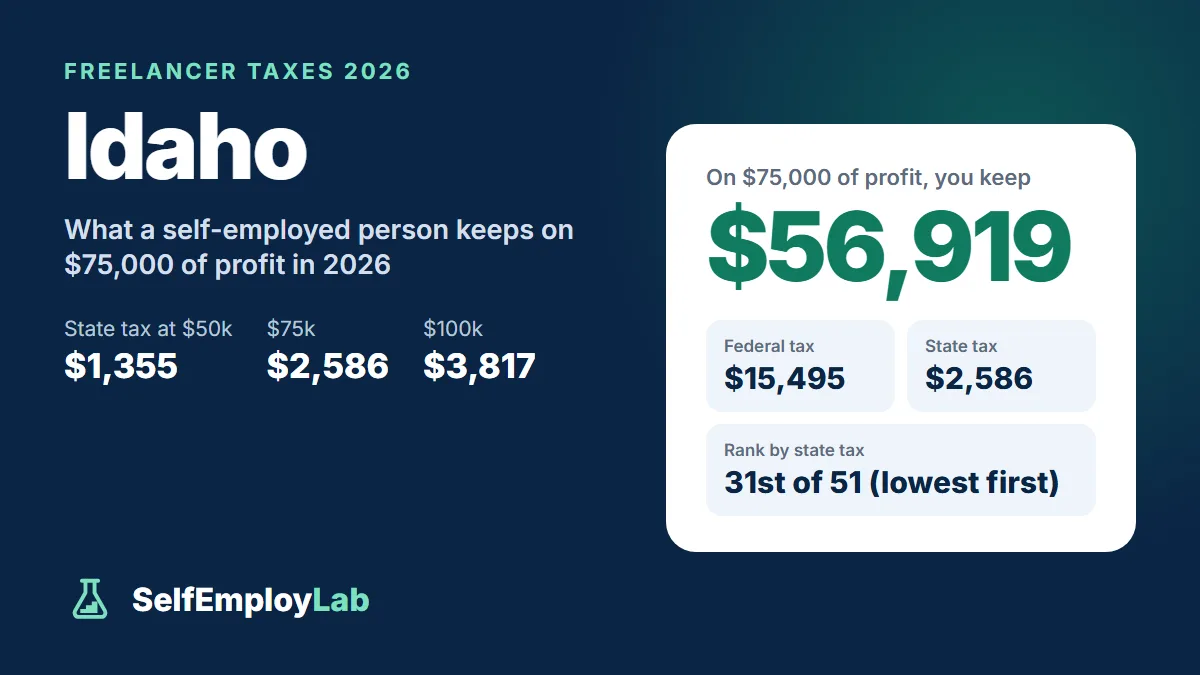
A single freelancer in Idaho with $75,000 of profit pays about $2,586 of Idaho income tax in 2026 on top of about $15,495 of federal tax (self-employment tax of 15.3% on 92.35% of profit plus income tax), keeping about $56,919. At $50,000 the state bill is about $1,355; at $100,000, about $3,817.
Idaho has a single 5.3% income tax rate and borrows the federal standard deduction, which keeps the math simple. The surprise for freelancers: Idaho doesn’t require individuals to make quarterly estimated payments at all. Here is what an Idaho freelancer owes.
How Idaho compares: in our 50-state take-home pay ranking, a single freelancer with $75,000 of profit keeps $56,919 in Idaho after federal and state income tax, 31st of 51 (state income tax: $2,586).
Set aside from every payment
—
That is $0 of every $1,000 you receive
- Federal income tax share
- —
- Self-employment tax share
- —
- State tax share
- —
- Total to save this year
- —
Estimate for information only — not tax, legal or financial advice. Federal figures for tax year 2026; state and local taxes are not included unless you enter them. Check your situation with a CPA or enrolled agent.
What you pay on freelance profit
| Tax | Rate |
|---|---|
| Federal self-employment tax | 15.3% on 92.35% of profit (12.4% part capped at $184,500 for 2026) |
| Federal income tax | 10%–37% |
| Idaho income tax | 0% on roughly the first $4,800 of taxable income, then 5.3% |
| Permanent building fund tax | $10 per return for most filers |
| City or county income tax | None |
Idaho’s 5.3% and the federal standard deduction
Idaho cut its rate from 5.695% to 5.3% starting in 2025, and that rate continues for 2026. For single filers, the first $4,811 of taxable income is taxed at 0% (the 2025 figure) and everything above it at 5.3%.
Idaho starts from your federal adjusted gross income, so Schedule C expenses and the deduction for half of your self-employment tax reduce your Idaho income too. House Bill 559, signed in February 2026, updated Idaho’s tie to the federal tax code, including the larger federal standard deduction, which is $16,100 for single filers in 2026. The federal QBI deduction does not carry over.
Two small items on the return
- Food tax credit: full-year Idaho residents get a credit for sales tax paid on groceries ($155 per person for 2025), which reduces your Idaho tax.
- Permanent building fund tax: most people required to file an Idaho return pay a flat $10. Filers below the filing threshold, people receiving Idaho public assistance, and legally blind filers are exempt.
Estimated payments are optional, but extensions aren’t free
The Idaho State Tax Commission does not require estimated payments from individuals. You can still prepay voluntarily at any time during the year with Form 51 or online, and the payments count toward your Idaho tax when you file.
The catch is the April 15 deadline. To get Idaho’s automatic six-month filing extension, you must have prepaid at least 80% of this year’s tax or 100% of last year’s. Miss that and penalties apply, and interest runs on anything paid after April 15 either way. Paying a quarter of your expected Idaho tax alongside each federal payment is the easiest way to stay safe. Size the federal part with the quarterly estimated tax calculator.
Sales tax and LLCs
- Idaho’s 6% sales tax applies to goods and a limited set of services. If you sell products or a taxable service, you need a seller’s permit from the Tax Commission.
- Idaho LLCs file an annual report with the Secretary of State each year to stay in good standing. Weighing an S corp election? It changes your federal self-employment tax, not Idaho’s 5.3% rate.
How much to set aside
Enter 5.3 in the state field of the tax set-aside calculator. Because Idaho uses the $16,100 federal standard deduction, your real Idaho cost is a little lower than that at modest incomes, so 5.3% builds in a small cushion.
Frequently asked questions
Do Idaho freelancers have to make estimated tax payments?
No. Idaho doesn't require estimated payments from individuals. However, to get Idaho's automatic six-month filing extension, you must have prepaid at least 80% of this year's tax or 100% of last year's by April 15, and interest runs on anything paid after that date.
What is Idaho's income tax rate in 2026?
5.3%. For single filers, the first $4,811 of taxable income is taxed at 0% (the 2025 figure) and the rest at 5.3%. Idaho uses the federal standard deduction, $16,100 for single filers in 2026, but not the QBI deduction.
What is Idaho's permanent building fund tax?
It's a flat $10 that most people required to file an Idaho return pay. Filers below the filing threshold, people receiving Idaho public assistance and legally blind filers are exempt.
Do freelancers charge sales tax in Idaho?
Only on taxable sales. Idaho's 6% sales tax applies to goods and a limited set of services. If you sell products or a taxable service, you need a seller's permit from the Idaho State Tax Commission.