Quick answer
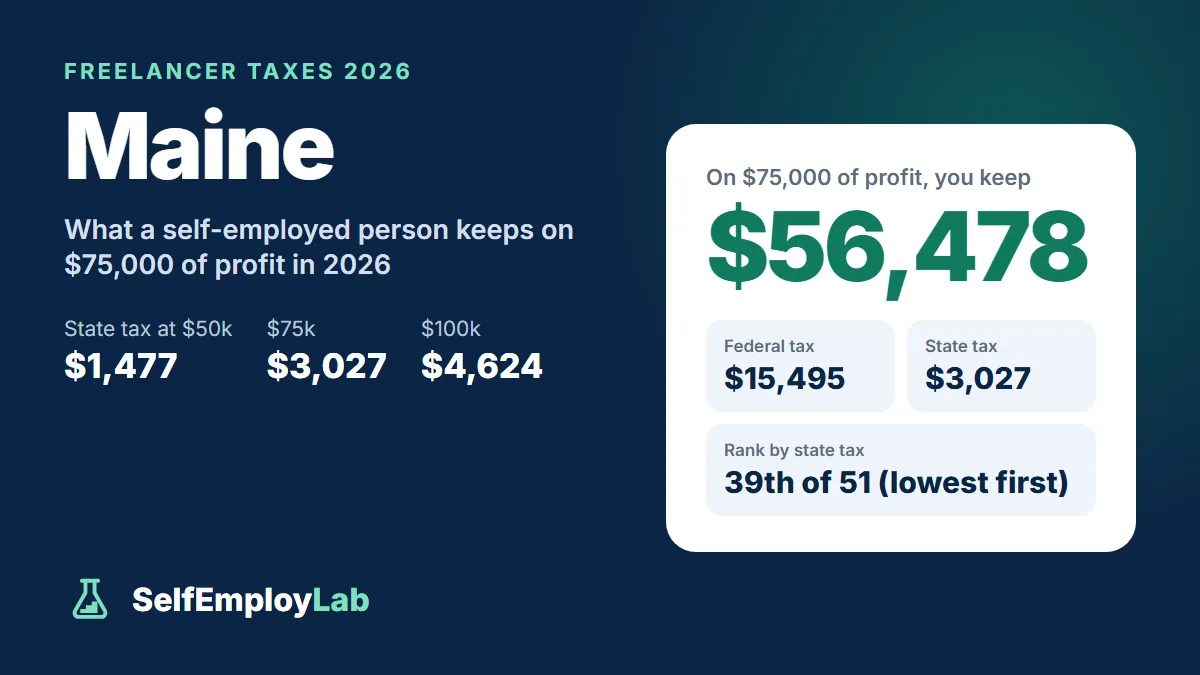
A single freelancer in Maine with $75,000 of profit pays about $3,027 of Maine income tax in 2026 on top of about $15,495 of federal tax (self-employment tax of 15.3% on 92.35% of profit plus income tax), keeping about $56,478. At $50,000 the state bill is about $1,477; at $100,000, about $4,624.
Maine taxes income at three rates, 5.8%, 6.75% and 7.15%, and the top rate starts at a fairly modest income. That puts Maine in the bottom half of our ranking for freelancers. Maine also sets its own standard deduction instead of copying the federal one, and it requires quarterly estimated payments once you owe $1,000 or more. Here is what a Maine freelancer owes.
How Maine compares: in our 50-state take-home pay ranking, a single freelancer with $75,000 of profit keeps $56,478 in Maine after federal and state income tax, 39th of 51 (state income tax: $3,027).
Set aside from every payment
—
That is $0 of every $1,000 you receive
- Federal income tax share
- —
- Self-employment tax share
- —
- State tax share
- —
- Total to save this year
- —
Estimate for information only — not tax, legal or financial advice. Federal figures for tax year 2026; state and local taxes are not included unless you enter them. Check your situation with a CPA or enrolled agent.
What you pay on freelance profit
| Tax | Rate |
|---|---|
| Federal self-employment tax | 15.3% on 92.35% of profit (12.4% part capped at $184,500 for 2026) |
| Federal income tax | 10%–37% |
| Maine income tax | 5.8%–7.15% for 2026 (7.15% above $64,850 of taxable income for single filers) |
| Maine income tax surcharge | Extra 2% on taxable income over $1,000,000 (single), starting in 2026 |
| City or county income tax | None |
Maine’s 2026 brackets
Maine adjusts its bracket thresholds for inflation each year. For single filers (and married filing separately), the 2026 schedule from Maine Revenue Services is:
- 5.8% on taxable income below $27,400
- 6.75% from $27,400 to $64,850
- 7.15% on $64,850 and above
For married couples filing jointly, the same rates switch at $54,850 and $129,750. Heads of household switch at $41,100 and $97,300.
New for 2026, Maine adds a 2% surcharge on taxable income above $1,000,000 for single filers ($1,500,000 for joint filers and heads of household, $750,000 for married filing separately). Few freelancers will reach it, but it is now part of the rate schedule.
Standard deduction, exemption and phase-outs
Maine starts from your federal adjusted gross income, so Schedule C expenses and the deduction for half of your self-employment tax reduce your Maine income too. The federal QBI deduction does not carry over.
From there, Maine uses its own numbers. The 2026 Maine standard deduction is $15,700 for single filers ($31,400 for joint filers), a little below the $16,100 federal amount. On top of that, Maine gives a $5,300 personal exemption per person, something the federal return doesn’t offer.
Both shrink at higher incomes. The standard deduction starts phasing out once Maine adjusted gross income passes $102,250 (single) and is gone $75,000 later. The personal exemption phases out above $341,000 for single filers. A freelancer with a strong year can lose part of the deduction well before reaching the top of the income scale.
Estimated payments
You must make Maine estimated payments if your expected Maine tax after withholding and credits is $1,000 or more and your prior-year tax was also $1,000 or more. For 2026, payments are due April 15, June 15 and September 15, 2026, and January 15, 2027. Pay online through the Maine Tax Portal or mail Form 1040ES-ME vouchers.
To avoid the underpayment penalty, each installment must be on time and your payments must total at least 90% of this year’s tax or 100% of last year’s. The penalty is figured installment by installment, so a large payment in January won’t fully cover a short April. Size the federal part with the quarterly estimated tax calculator and add a quarter of your expected Maine tax to each date.
Sales tax and LLCs
- Sales tax: Maine’s 5.5% sales tax applies to goods and a short list of services, such as telecommunications, fabrication, cable and satellite services, and digital audio and video services. Maine repealed its separate service provider tax on January 1, 2026 and moved those services into the 5.5% sales tax. Most professional and creative freelance services are not on the list, but if you sell products or a listed service, you need a sales tax account.
- LLC annual report: Maine LLCs file an annual report with the Secretary of State by June 1 each year, starting the year after formation. The fee is $85, and a late report adds a penalty. Weighing an S corp election? It changes your federal self-employment tax, not Maine’s income tax rates.
How much to set aside
Enter 6.75 in the state field of the tax set-aside calculator if your Maine taxable income will land between $27,400 and $64,850, or 7.15 above that. Because the $15,700 standard deduction and $5,300 exemption shield the first $21,000, your real Maine cost is lower than the bracket rate at modest incomes, so either figure builds in a cushion.
Frequently asked questions
What is Maine's income tax rate for freelancers in 2026?
Maine charges 5.8%, 6.75% and 7.15%. For single filers, 5.8% applies below $27,400 of taxable income, 6.75% from $27,400 to $64,850, and 7.15% above that. A new 2% surcharge applies to single filers' taxable income over $1,000,000.
When do Maine freelancers have to make estimated tax payments?
If your expected Maine tax after withholding and credits is $1,000 or more and your prior-year tax was also $1,000 or more. Payments are due April 15, June 15 and September 15, 2026, and January 15, 2027, online or with Form 1040ES-ME.
What is Maine's standard deduction for 2026?
$15,700 for single filers and $31,400 for joint filers, plus a $5,300 personal exemption per person. The standard deduction starts phasing out once Maine AGI passes $102,250 for single filers and is gone $75,000 later.
How much is the Maine LLC annual report fee?
$85. Maine LLCs file an annual report with the Secretary of State by June 1 each year, starting the year after formation. A late report adds a penalty.