Quick answer
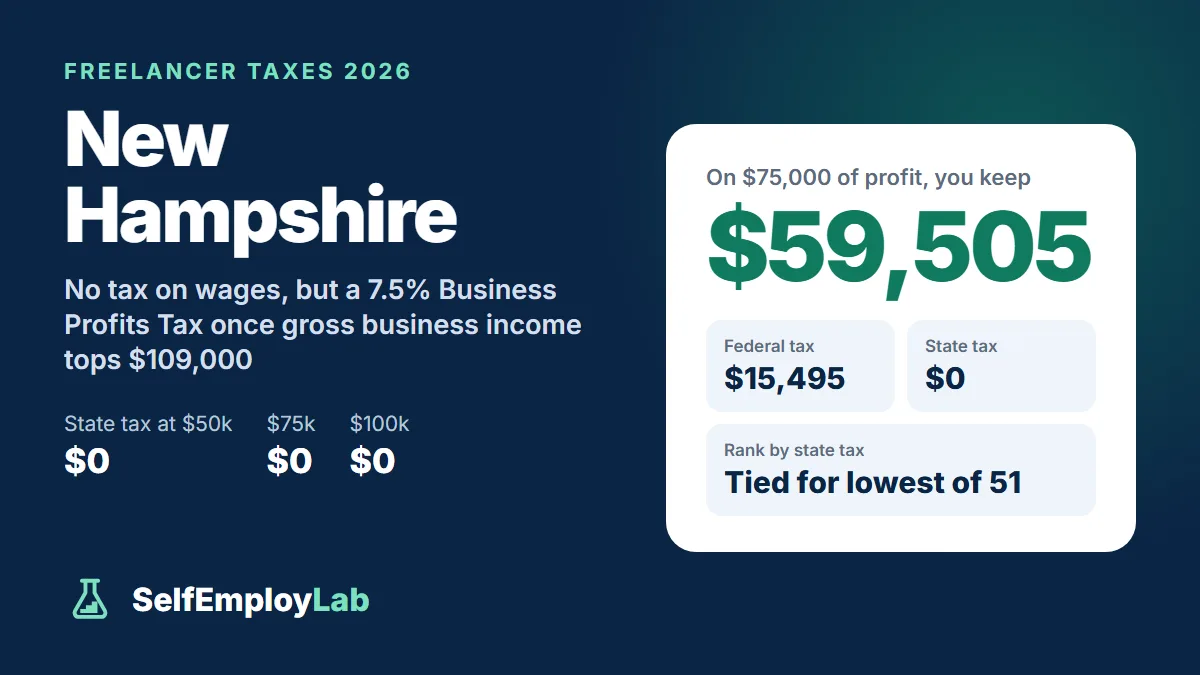
A single freelancer in New Hampshire with $75,000 of profit pays no New Hampshire income tax in 2026, but still owes about $15,495 of federal tax (self-employment tax of 15.3% on 92.35% of profit plus income tax), keeping about $59,505. Sole proprietors with more than $109,000 of gross business income also file the 7.5% Business Profits Tax.
New Hampshire has no tax on wages or on a freelancer’s personal income, and the old tax on interest and dividends is gone too. What it does have is a pair of business taxes, the Business Profits Tax and the Business Enterprise Tax, that reach sole proprietors once their revenue is high enough. Here is what a New Hampshire freelancer actually owes.
How New Hampshire compares: in our 50-state take-home pay ranking, a single freelancer with $75,000 of profit keeps $59,505 in New Hampshire after federal and state income tax, tied for 1st of 51 with the other places that charge this freelancer no state income tax. The ranking counts income taxes only; it does not include business taxes like the BPT or BET described below.
Set aside from every payment
—
That is $0 of every $1,000 you receive
- Federal income tax share
- —
- Self-employment tax share
- —
- State tax share
- —
- Total to save this year
- —
Estimate for information only — not tax, legal or financial advice. Federal figures for tax year 2026; state and local taxes are not included unless you enter them. Check your situation with a CPA or enrolled agent.
What you pay on freelance profit
| Tax | Rate |
|---|---|
| Federal self-employment tax | 15.3% on 92.35% of profit (12.4% part capped at $184,500 for 2026) |
| Federal income tax | 10%–37% |
| State personal income tax | None (Interest & Dividends Tax repealed from 2025) |
| Business Profits Tax (BPT) | 7.5% of business profits, only if gross business income is over $109,000 |
| Business Enterprise Tax (BET) | 0.55% of the enterprise value tax base, only above $298,000 of gross receipts or tax base |
| City or county income tax | None |
The Business Profits Tax applies to sole proprietors
Unlike most no-income-tax states, New Hampshire taxes the profits of unincorporated businesses, including sole proprietors. A single-member LLC that the IRS disregards is treated the same way: if the owner is an individual, it files Form NH-1040, the Proprietorship Business Profits Tax Return.
The rate is 7.5% (for taxable periods ending on or after December 31, 2023). You only have to file if your gross business income from all activities is more than $109,000, a threshold that took effect for periods beginning on or after January 1, 2025 and is adjusted every two years. A freelancer billing $90,000 a year owes no BPT at all. For calendar-year proprietors, the return is due April 15.
One quirk: New Hampshire’s business taxes follow the Internal Revenue Code as of December 31, 2018, so recent federal changes don’t automatically carry over.
The compensation deduction
This is what keeps the BPT small for most freelancers. A proprietor can deduct reasonable compensation for the personal services they actually perform for the business. It can’t exceed the earned income on your federal return, and it can’t push taxable profits below zero.
Under the Department of Revenue’s rules, a total compensation deduction of up to $75,000 is a safe harbor that needs no supporting records. A larger deduction is allowed if it is reasonable, but you must keep records showing that, using the federal standard for reasonable pay.
The Business Enterprise Tax
The BET is a 0.55% tax on the “enterprise value tax base”: compensation, interest and dividends the business pays. For a proprietor, that includes the compensation deduction you took for BPT and any self-employment earnings not covered by it. You must file only if gross receipts exceed $298,000 or the tax base exceeds $298,000 (thresholds for periods beginning on or after January 1, 2025). BET you pay can be used as a credit against your BPT, and unused credit carries forward for 10 years.
Estimated payments run on a different calendar
If your estimated BPT for the year is $200 or more, or your BET is $260 or more, New Hampshire expects quarterly estimates of 25% each. For calendar-year filers in 2026 they are due April 15, June 15, September 15 and December 15. Note the last one: it’s a month earlier than the federal January 15 payment. Missing them can trigger an underpayment penalty. Use the quarterly estimated tax calculator for the federal side.
Sales tax and LLCs
- New Hampshire has no general sales tax. Its 8.5% Meals and Rooms (Rentals) tax applies only to businesses selling meals, rooms or car rentals.
- New Hampshire LLCs file an annual report with the Secretary of State by April 1 each year. The fee is $100, with a $50 late fee. Weighing an S corp election? It changes your federal self-employment tax, not the BPT and BET thresholds.
How much to set aside
In the tax set-aside calculator, leave the state rate at 0. If your gross business income is under $109,000, that’s all you need. Above it, set aside 7.5% of whatever profit is left after your compensation deduction for the BPT.
Frequently asked questions
Does New Hampshire have a state income tax for freelancers?
No tax on personal income, and the Interest and Dividends Tax was repealed from 2025. But New Hampshire's 7.5% Business Profits Tax reaches sole proprietors whose gross business income from all activities is more than $109,000.
How does the New Hampshire compensation deduction lower the BPT?
A proprietor can deduct reasonable compensation for personal services performed for the business. A deduction of up to $75,000 is a safe harbor needing no supporting records; a larger one is allowed if you can show it's reasonable. It can't push taxable profits below zero.
When are New Hampshire business tax estimates due?
April 15, June 15, September 15 and December 15, 2026, in 25% installments, if your estimated BPT is $200 or more or BET is $260 or more. The last date is a month earlier than the federal January 15 payment.
How much is the New Hampshire LLC annual report fee?
$100. New Hampshire LLCs file an annual report with the Secretary of State by April 1 each year, with a $50 late fee. Separately, the 7.5% Business Profits Tax applies only if gross business income exceeds $109,000.