Quick answer
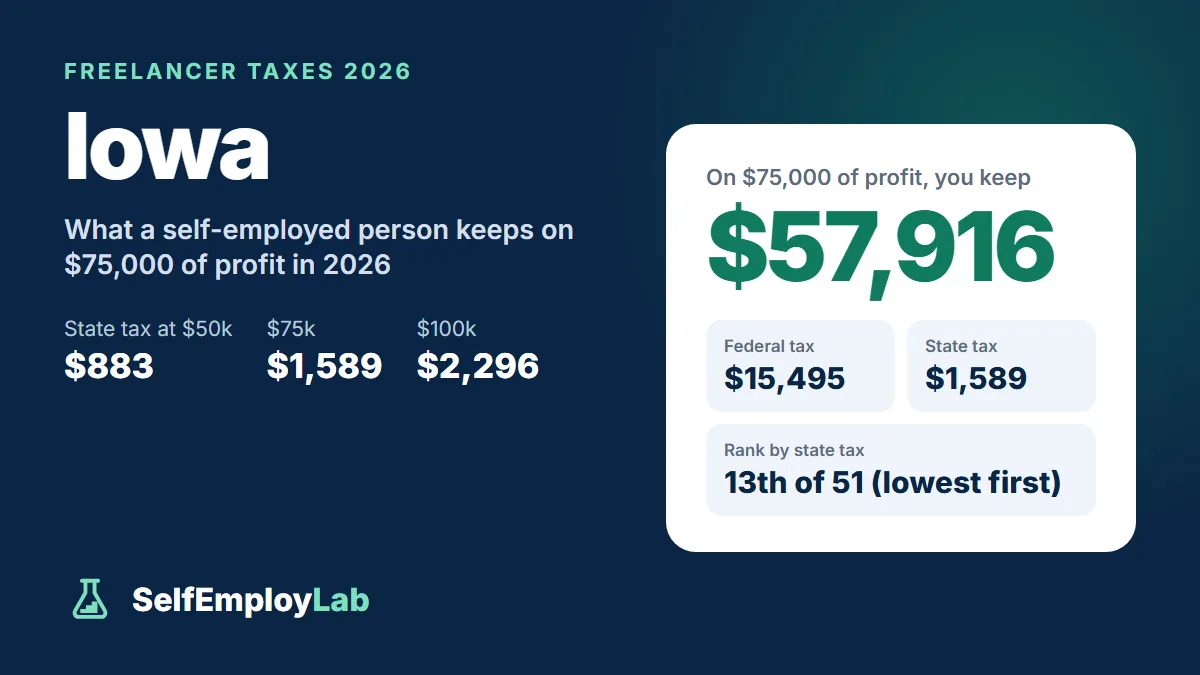
A single freelancer in Iowa with $75,000 of profit pays about $1,589 of Iowa income tax in 2026 on top of about $15,495 of federal tax (self-employment tax of 15.3% on 92.35% of profit plus income tax), keeping about $57,916. At $50,000 the state bill is about $883; at $100,000, about $2,296. Many school districts add an income surtax, not included.
Iowa now has one of the lighter income taxes in the Midwest: a flat 3.8% that starts from your federal taxable income, so the federal standard deduction and the QBI deduction lower your Iowa tax too. Iowa’s estimated payment due dates are different from the IRS dates, though. Here is what an Iowa freelancer owes for 2026.
How Iowa compares: in our 50-state take-home pay ranking, a single freelancer with $75,000 of profit keeps $57,916 in Iowa after federal and state income tax (before any local tax), 13th of 51 (state income tax: $1,589).
Set aside from every payment
—
That is $0 of every $1,000 you receive
- Federal income tax share
- —
- Self-employment tax share
- —
- State tax share
- —
- Total to save this year
- —
Estimate for information only — not tax, legal or financial advice. Federal figures for tax year 2026; state and local taxes are not included unless you enter them. Check your situation with a CPA or enrolled agent.
What you pay on freelance profit
| Tax | Rate |
|---|---|
| Federal self-employment tax | 15.3% on 92.35% of profit (12.4% part capped at $184,500 for 2026) |
| Federal income tax | 10%–37% |
| Iowa income tax | Flat 3.8% of Iowa taxable income |
| School district surtax | Set by each district, up to 20% of your Iowa income tax |
The flat 3.8%
For 2026 Iowa taxes all taxable income at a single 3.8% rate. Unlike most states, Iowa starts from federal taxable income, not federal AGI. Everything that lowers your federal taxable income lowers your Iowa income too: Schedule C expenses, the deduction for half of your self-employment tax, the federal standard deduction and the QBI deduction. Each person on the return then gets a $40 personal exemption credit.
School district surtax
Many Iowa school districts add an income surtax. It’s figured as a percentage of your Iowa income tax, not of your income. Each district sets its own rate, capped at 20%, and you pay it with your Iowa return. The Department of Revenue publishes the rate for each district every year. Residents of a handful of counties also pay an extra 1% local option surtax.
Estimated payments — note the Iowa dates
- Starting with 2026, you need to make Iowa estimated payments only if you expect to owe $1,000 or more on income not subject to withholding. The old threshold was $200.
- Payments use Form IA 1040ES and follow Iowa’s own calendar: April 30, June 30 and September 30, 2026, and January 31, 2027. That’s the last day of the month, not the 15th.
- To avoid an underpayment penalty, you can pay 100% of last year’s Iowa tax, or 110% if last year’s federal AGI was over $150,000.
Iowa returns are also due April 30, not April 15. Size your federal payments with the quarterly estimated tax calculator. Keep in mind that the IRS deadlines come two weeks or more before Iowa’s.
If you have an LLC
- A single-member LLC taxed as a sole proprietor reports its profit on your personal Iowa return.
- Iowa LLCs file a biennial report with the Secretary of State in odd-numbered years, due by April 1. The fee is $30 online or $45 on paper.
- Weighing an S corp election? The payroll-tax savings are federal, and Iowa still taxes the profit that passes through to you.
How much to set aside
Enter 3.8 in the state field of the tax set-aside calculator, and add a little for your school district surtax. Because Iowa tax starts after the federal standard deduction and QBI deduction, 3.8% of profit overstates your real Iowa cost, which leaves a cushion.
Sales tax
Iowa’s sales tax is 6%, plus a 1% local option tax where a county or city has adopted one. It applies to goods and to a specific list of services in Iowa law, which is longer than in most states. The list includes software as a service and information services. If you sell products, or your service is on the list, register with the Iowa Department of Revenue.
Frequently asked questions
When are Iowa estimated tax payments due?
Iowa uses its own dates: April 30, June 30 and September 30, 2026, and January 31, 2027. Starting with 2026, you need to pay with Form IA 1040ES only if you expect to owe $1,000 or more on income not subject to withholding, up from $200.
What is Iowa's income tax rate for 2026?
A flat 3.8%. Iowa starts from federal taxable income, so the federal standard deduction and QBI deduction lower your Iowa tax too. Each person on the return also gets a $40 personal exemption credit.
What is the Iowa school district surtax?
It's an extra income surtax many school districts add, figured as a percentage of your Iowa income tax, not your income. Each district sets its own rate, capped at 20%, and you pay it with your Iowa return.
Do I have to charge sales tax on services in Iowa?
Possibly. Iowa's 6% sales tax, plus a 1% local option tax where adopted, applies to goods and a specific list of services that's longer than in most states, including software as a service and information services. If your service is listed, register with the Iowa Department of Revenue.