Quick answer
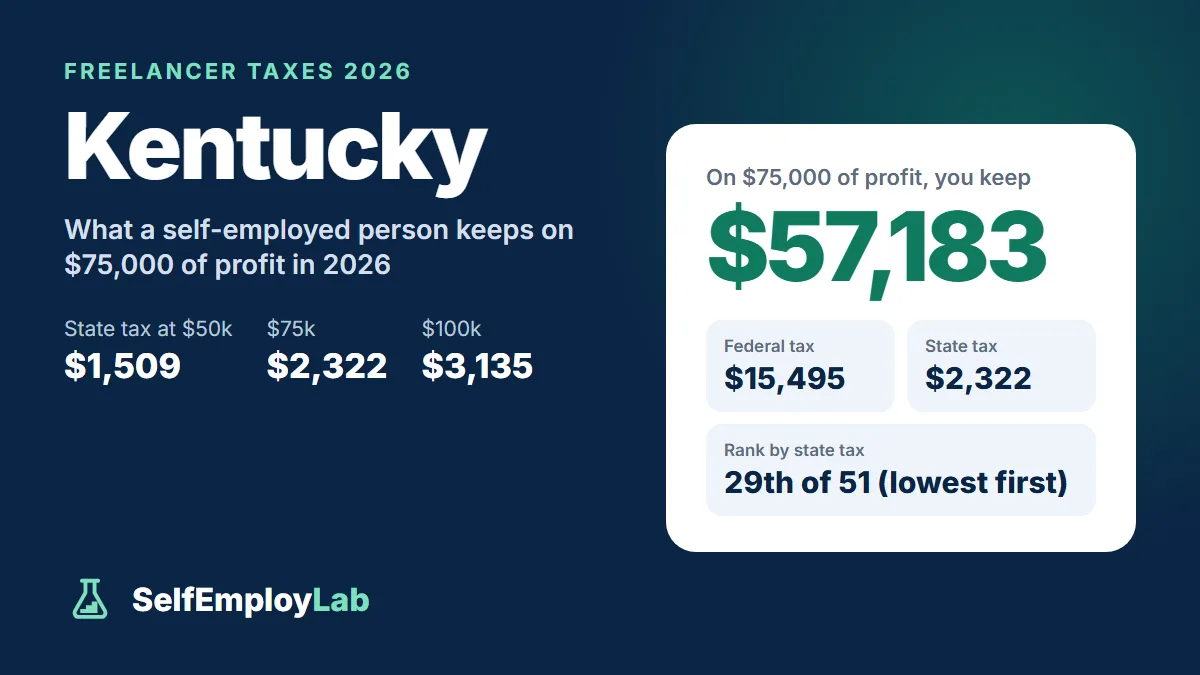
A single freelancer in Kentucky with $75,000 of profit pays about $2,322 of Kentucky income tax in 2026 on top of about $15,495 of federal tax (self-employment tax of 15.3% on 92.35% of profit plus income tax), keeping about $57,183. At $50,000 the state bill is about $1,509; at $100,000, about $3,135. Many cities and counties tax net profits (Louisville and Lexington about 2.2%), not included.
Kentucky has one of the lower flat income tax rates in the country, but it is also one of the few states where your city or county can tax your freelance profit too. Here is what a Kentucky freelancer owes at the state and local level, and how to pay it.
How Kentucky compares: in our 50-state take-home pay ranking, a single freelancer with $75,000 of profit keeps $57,183 in Kentucky after federal and state income tax (before any local tax), 29th of 51 (state income tax: $2,322).
Set aside from every payment
—
That is $0 of every $1,000 you receive
- Federal income tax share
- —
- Self-employment tax share
- —
- State tax share
- —
- Total to save this year
- —
Estimate for information only — not tax, legal or financial advice. Federal figures for tax year 2026; state and local taxes are not included unless you enter them. Check your situation with a CPA or enrolled agent.
What you pay on freelance profit
| Tax | Rate |
|---|---|
| Federal self-employment tax | 15.3% on 92.35% of profit (12.4% part capped at $184,500 for 2026) |
| Federal income tax | 10%–37% |
| Kentucky income tax | Flat 3.5% for 2026, after a $3,360 standard deduction |
| Local occupational license tax | Varies by city and county — for example 2.2% for Louisville Metro residents and 2.25% in Lexington-Fayette |
The flat 3.5%
For 2026, Kentucky taxes individual income at a flat 3.5%. Kentucky starts from your federal adjusted gross income, so your Schedule C business expenses and the deduction for half of your self-employment tax reduce your Kentucky income too. The federal standard deduction and the federal QBI deduction do not carry over; instead Kentucky gives its own, much smaller standard deduction of $3,360 for 2026.
Local occupational license taxes
This is the part that catches newcomers. Many Kentucky cities and counties charge an occupational license tax (also called a license fee) on wages and on the net profit of businesses, including sole proprietors. Two of the largest:
- Louisville Metro: the Louisville Metro Revenue Commission lists a 2.2% rate on the net profit of resident sole proprietors (non-residents pay a lower rate), reported on Form OL-3.
- Lexington-Fayette: the Lexington-Fayette Urban County Government charges a 2.25% occupational license fee on net profits and compensation.
The local tax is measured on business net profit under local rules, not on your Kentucky taxable income, so the state standard deduction doesn’t reduce it. Rates and filing rules vary by locality and can change; check your city and county revenue office before you set your budget.
Estimated payments
Kentucky expects estimated payments from people who expect more than $5,000 of income with no Kentucky withholding, but no payment is required if your estimated tax for the year is $500 or less. You can avoid an underpayment penalty by paying at least 90% of your 2026 tax or 100% of your 2025 tax (110% if your 2025 Kentucky AGI was over $150,000). Use Form 740-ES or pay online through the Department of Revenue. The due dates match the IRS: April 15, June 15 and September 15, 2026, and January 15, 2027. You don’t need to make Kentucky estimated payments if you had no Kentucky tax liability for 2025.
Size your federal payments with the quarterly estimated tax calculator, then add one quarter of your expected Kentucky tax to each payment date.
Sole proprietor vs LLC
- A sole proprietor simply reports business income on their personal Kentucky return.
- A single-member LLC owned by an individual still reports its profit on the owner’s Kentucky return, but it is also subject to Kentucky’s limited liability entity tax (LLET) and files Form 725. LLCs with $3 million or less of gross receipts or gross profits pay the $175 minimum.
- Kentucky LLCs file an annual report with the Secretary of State between January 1 and June 30 each year; the fee is $15.
- If you’re weighing an S corp election, remember S corporations are also subject to the LLET.
How much to set aside in Kentucky
In the tax set-aside calculator, enter 3.5 in the state field, plus your local rate if you have one — for a Louisville resident that would be 5.7 in total. Because Kentucky’s standard deduction is small, the flat rate is a close approximation of your real Kentucky cost on each extra dollar.
Sales tax
Kentucky’s sales tax is 6%, with no local sales taxes. Since 2023 Kentucky has taxed a longer list of services than most states, including photography, interior design, event planning and some recreational instruction. Since January 1, 2025, the first $12,000 a year of receipts from many of those newly taxable services is exempt. Most writing, consulting and similar professional work is still not taxable, but check the Department of Revenue’s list before assuming you don’t need a sales tax permit.
Frequently asked questions
Do Kentucky cities tax freelance income?
Yes, many do. Kentucky cities and counties can charge an occupational license tax on business net profit, including sole proprietors. Louisville Metro charges resident sole proprietors 2.2%, and Lexington-Fayette charges 2.25%. The state standard deduction doesn't reduce this local tax.
What is Kentucky's income tax rate for 2026?
A flat 3.5% for 2026, after Kentucky's own $3,360 standard deduction. Kentucky starts from federal AGI, so Schedule C expenses and the deduction for half of self-employment tax carry over, but the federal standard and QBI deductions don't.
When are Kentucky estimated tax payments due?
April 15, June 15 and September 15, 2026, and January 15, 2027, using Form 740-ES. Payments are expected if you expect more than $5,000 of income with no Kentucky withholding, but none are required if your estimated tax is $500 or less.
Do I have to charge sales tax on services in Kentucky?
Possibly. Kentucky's 6% sales tax covers more services than most states, including photography, interior design and event planning. Since January 1, 2025, the first $12,000 a year from many newly taxable services is exempt. Most writing and consulting work still isn't taxable.