Quick answer
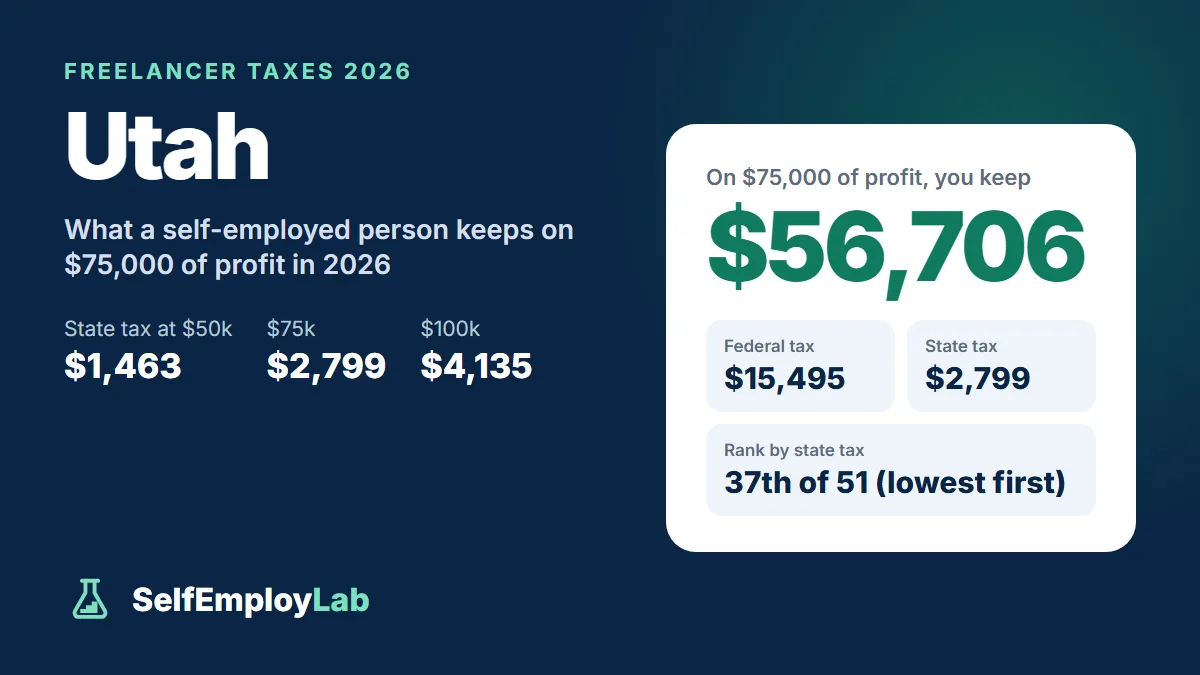
A single freelancer in Utah with $75,000 of profit pays about $2,799 of Utah income tax in 2026 on top of about $15,495 of federal tax (self-employment tax of 15.3% on 92.35% of profit plus income tax), keeping about $56,706. At $50,000 the state bill is about $1,463; at $100,000, about $4,135.
Utah has a flat income tax, and for 2026 the rate fell to 4.45%. Instead of a standard deduction, Utah gives you a tax credit that phases out as income rises, so most full-time freelancers pay close to the full rate. Here is what a Utah freelancer owes.
How Utah compares: in our 50-state take-home pay ranking, a single freelancer with $75,000 of profit keeps $56,706 in Utah after federal and state income tax, 37th of 51 (state income tax: $2,799).
Set aside from every payment
—
That is $0 of every $1,000 you receive
- Federal income tax share
- —
- Self-employment tax share
- —
- State tax share
- —
- Total to save this year
- —
Estimate for information only — not tax, legal or financial advice. Federal figures for tax year 2026; state and local taxes are not included unless you enter them. Check your situation with a CPA or enrolled agent.
What you pay on freelance profit
| Tax | Rate |
|---|---|
| Federal self-employment tax | 15.3% on 92.35% of profit (12.4% part capped at $184,500 for 2026) |
| Federal income tax | 10%–37% |
| Utah income tax | Flat 4.45% for 2026 (down from 4.5%) |
The 4.45% rate and the taxpayer tax credit
S.B. 60, passed in the 2026 session, cut Utah’s rate from 4.5% to 4.45%, retroactive to January 1, 2026. Utah applies that rate to your federal adjusted gross income after Utah’s own adjustments, so Schedule C business expenses and the deduction for half of your self-employment tax reduce Utah income too. The federal standard deduction and the QBI deduction don’t.
In place of a standard deduction, Utah gives a taxpayer tax credit. For a single filer who takes the federal standard deduction, the credit is 6% of that deduction, or $966. It shrinks by 1.3% of income over $18,696. The credit is gone at about $93,000 of income.
Because of the phase-out, each extra dollar of profit in that range costs about 5.75% in Utah tax (4.45% plus 1.3%), not 4.45%.
No quarterly estimates, but there is a prepayment rule
Utah does not require quarterly estimated tax payments. You get an automatic six-month extension to file, but not to pay. To avoid penalties, your withholding and prepayments by the original April due date must equal at least:
- 90% of this year’s Utah tax, or
- 100% of last year’s Utah tax.
Most freelancers find it easiest to prepay during the year anyway, through the Taxpayer Access Point (TAP) or with Form TC-546. Interest runs on any tax not paid by the April due date. Size your federal quarterly payments with the quarterly estimated tax calculator, and set aside the Utah share alongside them.
If you have an LLC
- A single-member LLC taxed as a sole proprietor reports its profit on your personal Utah return (TC-40).
- Utah LLCs renew with the Division of Corporations and Commercial Code every year, due on the anniversary of registration. Renewal opens 60 days before that date. The fee schedule effective July 1, 2025 lists the LLC renewal at $18, with a $10 late fee.
- Weighing an S corp election? The payroll-tax savings are federal, and Utah still taxes the profit that passes through to you at 4.45%.
How much to set aside
Enter 4.45 in the state field of the tax set-aside calculator. Because the taxpayer tax credit is small and phases out, the flat rate is a close approximation of your real Utah cost on full-time freelance income.
Sales tax
According to the Utah State Tax Commission, professional and consulting services that aren’t performed on tangible personal property are not subject to sales tax. Labor to repair, renovate or clean tangible personal property is taxable. If you sell physical products or taxable services, register for a Utah sales tax license.
Frequently asked questions
What is Utah's income tax rate for 2026?
A flat 4.45%, cut from 4.5% by S.B. 60 and retroactive to January 1, 2026. Instead of a standard deduction, Utah gives a taxpayer tax credit of $966 for single filers, which shrinks by 1.3% of income over $18,696.
Do Utah freelancers have to make quarterly estimated payments?
No. Utah doesn't require quarterly estimated payments. But to avoid penalties, your withholding and prepayments by the original April due date must equal at least 90% of this year's Utah tax or 100% of last year's. Interest runs on tax not paid by then.
Do I have to charge sales tax on services in Utah?
Usually not. According to the Utah State Tax Commission, professional and consulting services not performed on tangible personal property aren't subject to sales tax. Labor to repair, renovate or clean tangible personal property is taxable.
How much does a Utah LLC renewal cost?
$18. Utah LLCs renew with the Division of Corporations and Commercial Code each year on the anniversary of registration, under the fee schedule effective July 1, 2025. A late renewal adds a $10 fee.