Quick answer
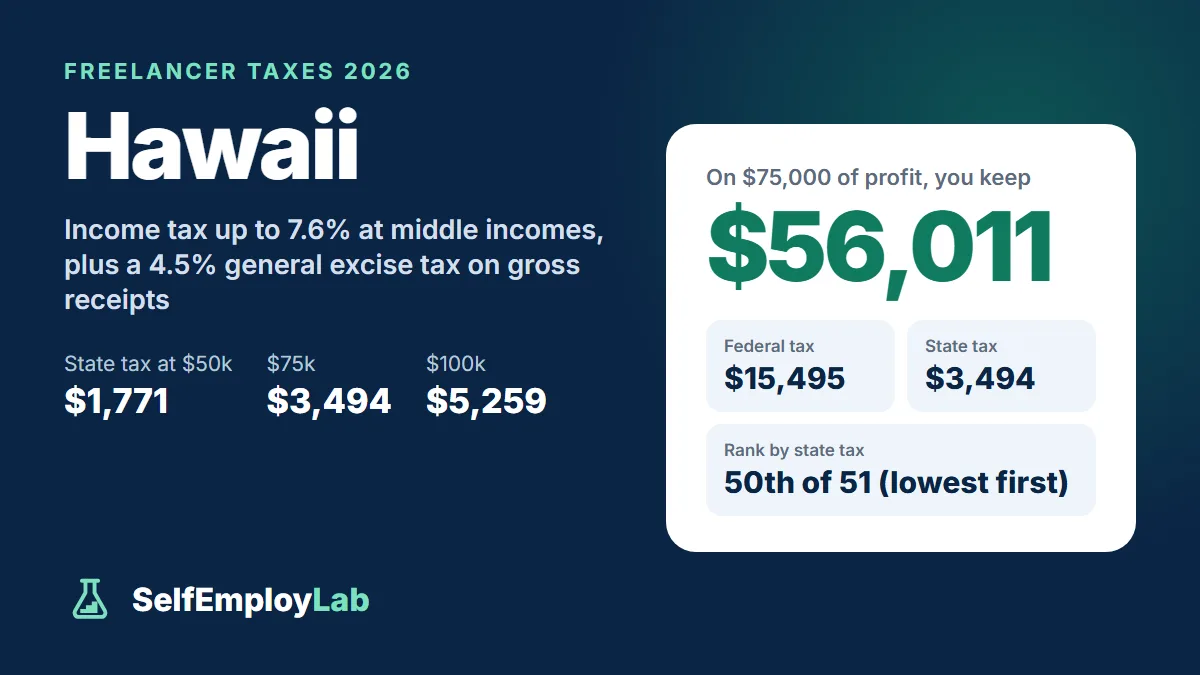
A single freelancer in Hawaii with $75,000 of profit pays about $3,494 of Hawaii income tax in 2026 on top of about $15,495 of federal tax (self-employment tax of 15.3% on 92.35% of profit plus income tax), keeping about $56,011. At $50,000 the state bill is about $1,771; at $100,000, about $5,259. Hawaii also charges a 4.5% general excise tax on gross receipts.
Hawaii is one of the most expensive states for freelancers. Its income tax brackets reach the high single digits at middle incomes, and on top of that Hawaii charges a general excise tax (GET) on the gross receipts of almost every business, including service businesses. Here is what a Hawaii freelancer owes.
How Hawaii compares: in our 50-state take-home pay ranking, a single freelancer with $75,000 of profit keeps $56,011 in Hawaii after federal and state income tax, 50th of 51 (state income tax: $3,494).
Set aside from every payment
—
That is $0 of every $1,000 you receive
- Federal income tax share
- —
- Self-employment tax share
- —
- State tax share
- —
- Total to save this year
- —
Estimate for information only — not tax, legal or financial advice. Federal figures for tax year 2026; state and local taxes are not included unless you enter them. Check your situation with a CPA or enrolled agent.
What you pay on freelance profit
| Tax | Rate |
|---|---|
| Federal self-employment tax | 15.3% on 92.35% of profit (12.4% part capped at $184,500 for 2026) |
| Federal income tax | 10%–37% |
| Hawaii income tax | 1.4%–11% (7.6% from $48,000 to $125,000 of taxable income for single filers) |
| General excise tax (GET) | 4% of gross receipts, 4.5% with the county surcharge on every island |
Hawaii income tax
For 2026, Hawaii uses the bracket schedule set by Act 46 (2024). For single filers, the first $9,600 of taxable income is taxed at 1.4%, then rates step up through 3.2%, 5.5%, 6.4%, 6.8% and 7.2%, reaching 7.6% on taxable income from $48,000 to $125,000, with higher brackets above that. Act 46 also doubled the standard deduction: it is $8,000 for single filers in 2026 (up from $4,400 in 2025), plus a $1,144 personal exemption.
Hawaii starts from your federal adjusted gross income, so Schedule C expenses and the deduction for half of your self-employment tax carry over. Hawaii did not adopt the federal QBI deduction. A 2026 law (Act 24) changes the brackets again starting in 2027; it does not affect 2026.
Estimated payments — note the 20th
You generally must make Hawaii estimated payments if you expect to owe at least $500 after withholding and credits. To avoid a penalty, prepay the smaller of 60% of this year’s tax or 100% of last year’s. Hawaii’s dates fall on the 20th, not the 15th: April 20, June 20 and September 20, 2026, and January 20, 2027. Pay online at hitax.hawaii.gov or mail Form N-200V.
Size your federal payments with the quarterly estimated tax calculator, then add a quarter of your expected Hawaii tax to each Hawaii date.
The general excise tax applies to services
Hawaii has no sales tax. Instead, the GET is a tax on the business, charged on gross income from nearly every business activity, including professional and other services. It applies to your gross receipts, not your profit, so expenses don’t reduce it.
- Rate: 4% for most activities, plus a 0.5% county surcharge on Oahu, Maui, Kauai and Hawaii Island, for 4.5% in total.
- Passing it on: you may add GET to your invoices but don’t have to. The maximum visible pass-on rate with the surcharge is 4.712%, because the tax you collect is itself taxable income.
- License: every person doing business in Hawaii needs a GET license, obtained with Form BB-1 and a one-time $20 fee.
- Filing: periodic Form G-45 returns are due by the 20th of the month after each period. You can file semiannually if your GET is $2,000 or less for the year, quarterly up to $4,000, and monthly above that. An annual Form G-49 is due April 20.
- Out-of-state clients: services sold for use or consumption outside Hawaii can be exempt if the customer gives you Form G-61.
Example: $100,000 of billings to Oahu clients means about $4,500 of GET if you don’t pass it on.
If you have an LLC
Hawaii LLCs file an annual report with the DCCA Business Registration Division ($15 annual report fee). If you’re weighing an S corp election, remember that GET is charged to the entity on gross receipts whatever its tax classification.
How much to set aside
Enter 7.6 in the state field of the tax set-aside calculator if your Hawaii taxable income falls between $48,000 and $125,000. Then set aside GET separately: about 4.5% of what you bill to Hawaii clients, unless you add it to your invoices.
Frequently asked questions
Does Hawaii tax freelance services?
Yes. Hawaii's general excise tax applies to gross receipts from nearly every business, including services. The rate is 4%, or 4.5% with the county surcharge on Oahu, Maui, Kauai and Hawaii Island. It's charged on receipts, not profit, so expenses don't reduce it.
When are Hawaii estimated tax payments due?
On the 20th, not the 15th: April 20, June 20 and September 20, 2026, and January 20, 2027. You generally must pay if you expect to owe at least $500, and prepaying the smaller of 60% of this year's tax or 100% of last year's avoids a penalty.
Do freelancers need a GET license in Hawaii?
Yes. Every person doing business in Hawaii needs a general excise tax license, obtained with Form BB-1 and a one-time $20 fee. Periodic Form G-45 returns are due by the 20th of the month after each period.
What is Hawaii's income tax rate for freelancers?
Hawaii's rates run from 1.4% to 11%. For single filers, taxable income from $48,000 to $125,000 is taxed at 7.6%. The 2026 standard deduction is $8,000 for single filers, plus a $1,144 personal exemption.