Quick answer
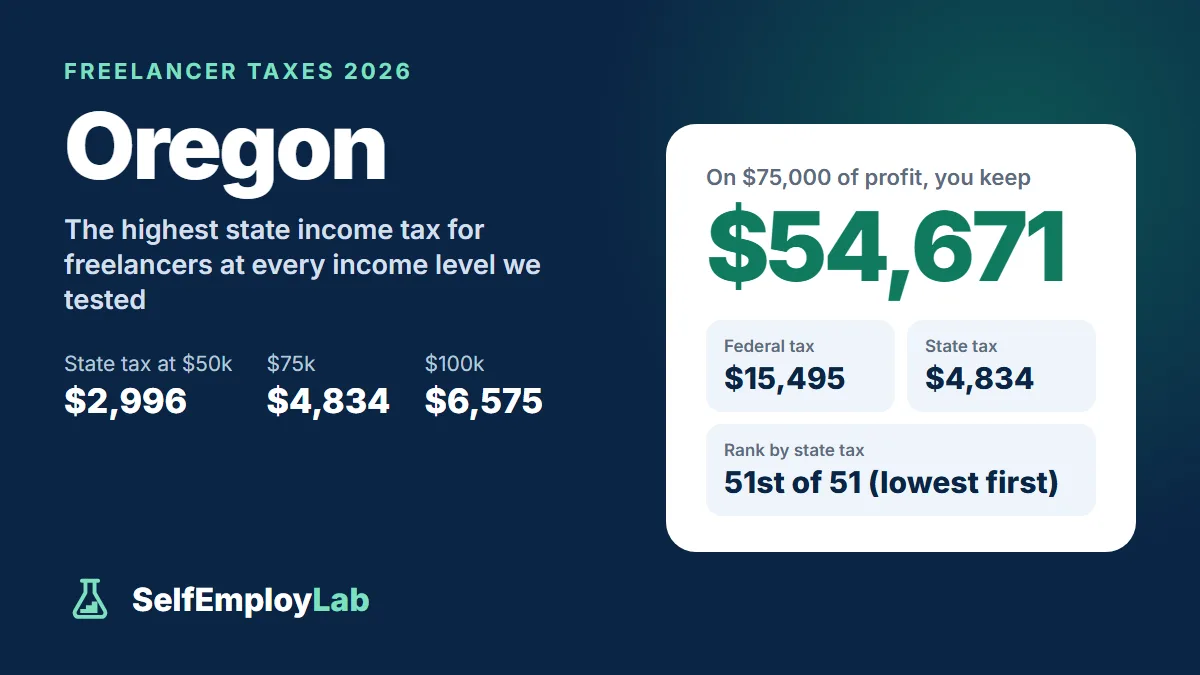
A single freelancer in Oregon with $75,000 of profit pays about $4,834 of Oregon income tax in 2026 on top of about $15,495 of federal tax (self-employment tax of 15.3% on 92.35% of profit plus income tax), keeping about $54,671. At $50,000 the state bill is about $2,996; at $100,000, about $6,575. Portland and Multnomah County add business and income taxes, not included.
Oregon has no sales tax, but it has one of the heaviest income taxes on freelance profit in the country: the 8.75% bracket starts at just $11,400 of taxable income. In the Portland area, several local taxes can sit on top of that. Here is what an Oregon freelancer owes and how to plan for it.
How Oregon compares: in our 50-state take-home pay ranking, a single freelancer with $75,000 of profit keeps $54,671 in Oregon after federal and state income tax (before any local tax), 51st of 51 (state income tax: $4,834).
Set aside from every payment
—
That is $0 of every $1,000 you receive
- Federal income tax share
- —
- Self-employment tax share
- —
- State tax share
- —
- Total to save this year
- —
Estimate for information only — not tax, legal or financial advice. Federal figures for tax year 2026; state and local taxes are not included unless you enter them. Check your situation with a CPA or enrolled agent.
What you pay on freelance profit
| Tax | Rate |
|---|---|
| Federal self-employment tax | 15.3% on 92.35% of profit (12.4% part capped at $184,500 for 2026) |
| Federal income tax | 10%–37% |
| Oregon income tax | 4.75%–9.9%; 8.75% on taxable income over $11,400 (single) |
| TriMet self-employment tax | 0.8237% of net self-employment earnings from work in the TriMet district |
| Portland and Multnomah County business taxes | 2.6% (city) and 2% (county) of net business income, above gross-receipts exemptions |
| Metro and Multnomah County personal income taxes | Only on higher incomes — see below |
| Sales tax | None |
Oregon’s brackets for 2026
| Oregon taxable income (single) | Rate |
|---|---|
| Up to $4,550 | 4.75% |
| $4,550–$11,400 | 6.75% |
| $11,400–$125,000 | 8.75% |
| Over $125,000 | 9.9% |
Oregon starts from your federal income, so Schedule C expenses and the deduction for half of your self-employment tax carry over. From there:
- The standard deduction is small: $2,910 for a single filer.
- You get a personal exemption credit of $263, but not if your federal AGI is over $100,000 (single).
- Oregon lets you subtract the federal income tax you paid, up to $8,750. That subtraction phases down as AGI rises from $125,000 to $145,000. It covers federal income tax only, not self-employment tax.
Estimated payments
You must make Oregon estimated payments if you expect to owe $1,000 or more after credits and withholding. To avoid underpayment interest, pay at least the smallest of 90% of your 2026 tax, 100% of your 2025 tax, or 90% of the tax on your annualized 2026 income. Oregon’s estimate covers income tax only; self-employment tax goes to the IRS.
The 2026 due dates match the IRS: April 15, June 15 and September 15, 2026, and January 15, 2027. Pay online through the Department of Revenue, or mail a check with Form OR-40-V. Size your federal payments with the quarterly estimated tax calculator, then add one quarter of your expected Oregon tax to each date.
Portland-area local taxes
Where you live and work in the Portland area decides which of these apply. The City of Portland’s Revenue Division administers the business taxes and the Metro and Multnomah County personal income taxes.
- Portland Business License Tax and Multnomah County Business Income Tax: 2.6% and 2% of net business income for 2025, filed on one combined return. You’re exempt below a gross-receipts threshold. For the city that’s $50,000 for 2025, rising to $75,000 for 2026 and $100,000 for 2027 under an ordinance passed in April 2026. The county threshold is $100,000. Sole proprietors can take an owner’s compensation deduction (for 2025, up to $160,500 per owner for the city and $158,500 for the county), which cuts the taxable amount a lot.
- Metro Supportive Housing Services tax: 1% of taxable income above $128,000 for a single filer in 2026 ($125,000 through 2025). From 2026 the threshold is indexed for inflation.
- Multnomah County Preschool for All tax: 1.5% of taxable income above $125,000 for a single filer, plus another 1.5% above $250,000. The rate is scheduled to rise by 0.8% in 2028.
- From 2026, estimated payments for the Metro and Preschool for All taxes are required only once you owe $5,000 or more for a program (it was $1,000 before).
- TriMet self-employment tax: 0.8237% of net self-employment earnings from business done in the TriMet district (parts of Multnomah, Clackamas and Washington counties). It applies once net self-employment earnings are over $400. You file it on Form OR-TM with the Oregon Department of Revenue, separately from your income tax return, and include your federal Schedule SE. The Lane Transit District has a similar tax, filed on Form OR-LTD.
- Portland Arts Tax: $50 for a single filer for 2026 if you’re a Portland resident aged 18 or over and your Oregon taxable income is over $20,000.
Sole proprietor vs LLC
- A sole proprietor or single-member LLC taxed as a sole proprietor reports business income on the personal Oregon return (Form OR-40).
- Oregon LLCs file an annual report with the Secretary of State. The state fee is $100, and you can file it online yourself. Ignore mailers that charge more.
- With an S corp election, S corporation distributions aren’t subject to the TriMet self-employment tax. Wages you pay yourself for work in the district are subject to the transit payroll tax instead.
- Oregon’s Corporate Activity Tax doesn’t affect typical freelancers. You register at $750,000 of Oregon commercial activity and owe tax only above $1 million.
How much to set aside in Oregon
In the tax set-aside calculator, enter 8.75 in the state field. That’s the rate on each extra dollar for most freelancers. The federal tax subtraction pulls the real cost slightly lower, so 8.75 errs on the safe side. If you work in the TriMet district, add about 0.8 for the transit tax.
Sales tax
Oregon has no general sales tax, so you don’t collect sales tax on services or goods sold in Oregon.
Frequently asked questions
What is Oregon's income tax rate for freelancers?
4.75% to 9.9%. For single filers, the 8.75% bracket starts at just $11,400 of taxable income and runs to $125,000. The standard deduction is only $2,910, though Oregon lets you subtract federal income tax paid, up to $8,750.
Do Oregon freelancers pay the TriMet self-employment tax?
Yes, if you do business in the TriMet district. It's 0.8237% of net self-employment earnings from work in the district, once those earnings are over $400. You file Form OR-TM with the Oregon Department of Revenue, separately from your income tax return.
Do Portland freelancers pay city and county business taxes?
Above certain receipts, yes. Portland's Business License Tax is 2.6% and Multnomah County's Business Income Tax is 2% of net business income. The city exemption threshold rises to $75,000 of gross receipts for 2026; the county's is $100,000.
Does Oregon charge sales tax on freelance services?
No. Oregon has no general sales tax, so you don't collect sales tax on services or goods sold in Oregon. The trade-off is a heavy income tax, with the 8.75% bracket starting at $11,400 of taxable income for single filers.