Quick answer
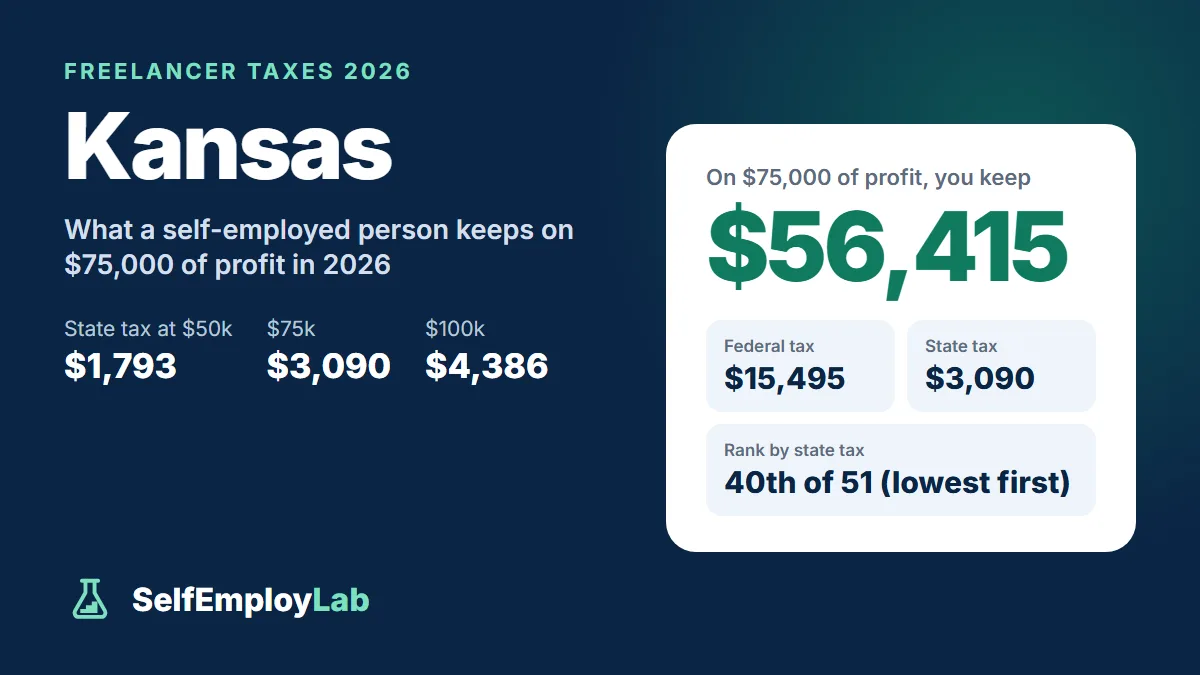
A single freelancer in Kansas with $75,000 of profit pays about $3,090 of Kansas income tax in 2026 on top of about $15,495 of federal tax (self-employment tax of 15.3% on 92.35% of profit plus income tax), keeping about $56,415. At $50,000 the state bill is about $1,793; at $100,000, about $4,386.
Kansas has two income tax brackets, a small standard deduction and a large personal exemption. Almost all of a freelancer’s income lands in the 5.58% bracket, and a planned rate cut didn’t happen for 2026. Here is what a Kansas freelancer owes for 2026.
How Kansas compares: in our 50-state take-home pay ranking, a single freelancer with $75,000 of profit keeps $56,415 in Kansas after federal and state income tax, 40th of 51 (state income tax: $3,090).
Set aside from every payment
—
That is $0 of every $1,000 you receive
- Federal income tax share
- —
- Self-employment tax share
- —
- State tax share
- —
- Total to save this year
- —
Estimate for information only — not tax, legal or financial advice. Federal figures for tax year 2026; state and local taxes are not included unless you enter them. Check your situation with a CPA or enrolled agent.
What you pay on freelance profit
| Tax | Rate |
|---|---|
| Federal self-employment tax | 15.3% on 92.35% of profit (12.4% part capped at $184,500 for 2026) |
| Federal income tax | 10%–37% |
| Kansas income tax | 5.2% on the first $23,000 of taxable income, 5.58% above (single) |
Kansas’s two brackets
For a single filer, Kansas taxes the first $23,000 of taxable income at 5.2% and everything above that at 5.58%. Married couples filing jointly get a $46,000 first bracket. Kansas law allows further cuts in years when state revenue meets certain targets, but the Department of Revenue certified in Notice 25-06 that the targets weren’t met, so there is no rate cut for 2026.
Kansas starts from your federal adjusted gross income, so Schedule C business expenses and the deduction for half of your self-employment tax reduce Kansas income too. The federal standard deduction and the QBI deduction don’t carry over. Instead, a single filer gets Kansas’s $3,605 standard deduction and a $9,160 personal exemption.
Estimated payments
- You must make estimated payments with Form K-40ES if you expect to owe $500 or more of Kansas tax after withholding and credits, and your withholding and credits may be less than the smaller of 90% of your 2026 tax or 100% of your 2025 tax.
- Due dates match the IRS: April 15, June 15 and September 15, 2026, and January 15, 2027. You can skip the January payment if you file your 2026 return and pay the tax in full by January 31, 2027.
- You can pay online through the Kansas Department of Revenue payment portal or mail the voucher. Schedule K-210 figures any underpayment penalty.
Size your federal payments with the quarterly estimated tax calculator, then add one quarter of your expected Kansas tax to each date.
If you have an LLC
- A single-member LLC taxed as a sole proprietor reports its profit on your personal Kansas return.
- Kansas LLCs file an information report with the Secretary of State every two years, by April 15 of the even or odd year that matches the year the LLC was formed. The fee is $90 online or $110 on paper. An LLC that is still behind three months after the due date forfeits its registration.
- Weighing an S corp election? The payroll-tax savings are federal, and Kansas still taxes the profit that passes through to you.
How much to set aside
Enter 5.58 in the state field of the tax set-aside calculator. That’s your Kansas rate on each extra dollar of profit. The standard deduction, the exemption and the 5.2% bracket bring your average Kansas rate lower, so this leaves a cushion.
Sales tax
Kansas’s state sales tax rate is 6.5%, and cities and counties add their own. Besides goods, Kansas taxes labor to install, apply, repair, alter or maintain tangible property. Professional services such as accounting and legal work aren’t taxed. If you sell products or do that kind of hands-on work, register with the Kansas Department of Revenue.
Frequently asked questions
What is Kansas's income tax rate for freelancers in 2026?
For single filers, Kansas taxes the first $23,000 of taxable income at 5.2% and everything above at 5.58%. There's no rate cut for 2026 because revenue targets weren't met. Married couples filing jointly get a $46,000 first bracket.
When are Kansas estimated tax payments due?
April 15, June 15 and September 15, 2026, and January 15, 2027, using Form K-40ES if you expect to owe $500 or more. You can skip the January payment if you file your 2026 return and pay in full by January 31, 2027.
How often does a Kansas LLC file a report?
Every two years. Kansas LLCs file an information report with the Secretary of State by April 15 of the even or odd year matching their formation year. The fee is $90 online or $110 on paper.
Do Kansas freelancers have to charge sales tax on services?
Usually not for professional services. Accounting and legal work aren't taxed, but Kansas taxes labor to install, apply, repair, alter or maintain tangible property. The state rate is 6.5%, and cities and counties add their own.