Quick answer
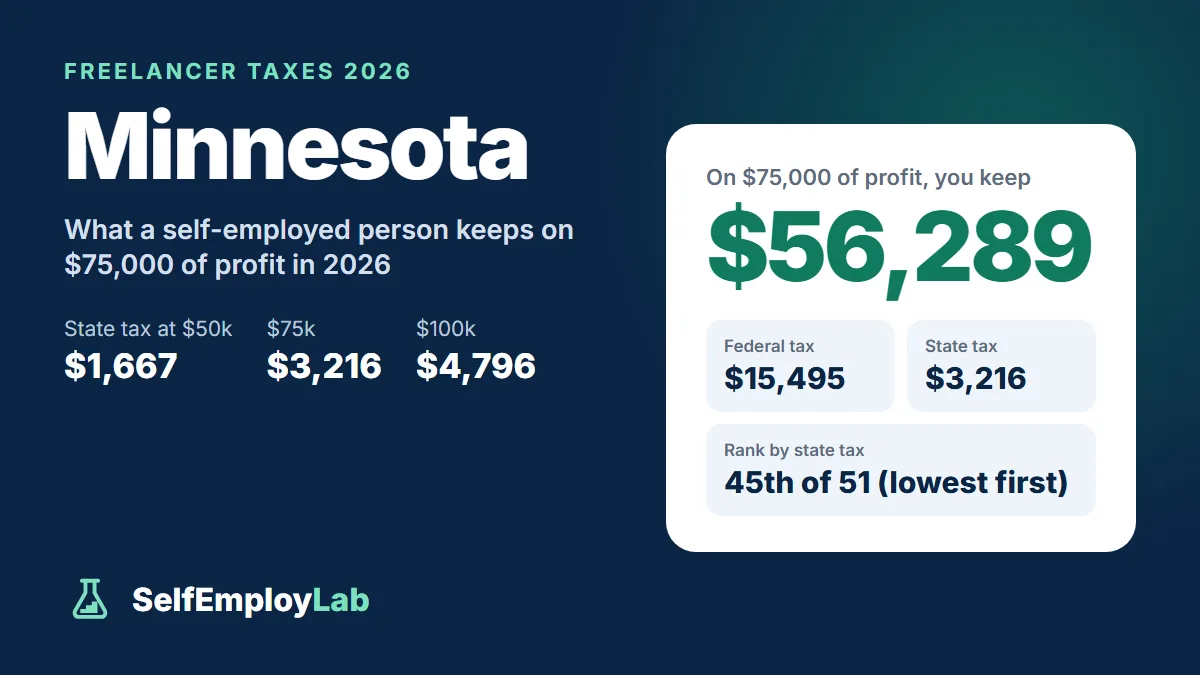
A single freelancer in Minnesota with $75,000 of profit pays about $3,216 of Minnesota income tax in 2026 on top of about $15,495 of federal tax (self-employment tax of 15.3% on 92.35% of profit plus income tax), keeping about $56,289. At $50,000 the state bill is about $1,667; at $100,000, about $4,796.
Minnesota is a high-tax state for freelancers. It has four brackets running from 5.35% to 9.85%, and there’s no state version of the federal QBI deduction. The upside is simplicity: no city or county income taxes, and estimated payments on the IRS calendar. Here is what a Minnesota freelancer owes.
How Minnesota compares: in our 50-state take-home pay ranking, a single freelancer with $75,000 of profit keeps $56,289 in Minnesota after federal and state income tax (before any local tax), 45th of 51 (state income tax: $3,216).
Set aside from every payment
—
That is $0 of every $1,000 you receive
- Federal income tax share
- —
- Self-employment tax share
- —
- State tax share
- —
- Total to save this year
- —
Estimate for information only — not tax, legal or financial advice. Federal figures for tax year 2026; state and local taxes are not included unless you enter them. Check your situation with a CPA or enrolled agent.
What you pay on freelance profit
| Tax | Rate |
|---|---|
| Federal self-employment tax | 15.3% on 92.35% of profit (12.4% part capped at $184,500 for 2026) |
| Federal income tax | 10%–37% |
| Minnesota income tax | 5.35%–9.85% of Minnesota taxable income |
| City or county income tax | None |
Minnesota’s brackets for 2026
| Minnesota taxable income (single) | Rate |
|---|---|
| Up to $33,310 | 5.35% |
| $33,310–$109,430 | 6.8% |
| $109,430–$203,150 | 7.85% |
| Over $203,150 | 9.85% |
Minnesota starts from your federal adjusted gross income, so Schedule C expenses and the deduction for half of your self-employment tax reduce your Minnesota income too. Then you take Minnesota’s own standard deduction ($15,300 for a single filer in 2026). The federal QBI deduction does not carry over, which is the main reason a freelancer’s Minnesota bill runs higher than the brackets alone suggest.
A 2026 law updated Minnesota’s link to the federal tax code, including the 2025 federal tax law. Minnesota still makes you add back 80% of federal bonus depreciation in the year you claim it and deduct that amount over the next five years. That matters if you write off a big equipment purchase in one year.
Estimated payments
You must pay Minnesota estimated tax if you expect to owe $500 or more after withholding and refundable credits. To avoid a penalty, pay at least 90% of this year’s tax or 100% of last year’s (110% if your federal AGI was over $150,000).
The due dates match the IRS: April 15, June 15 and September 15, 2026, and January 15, 2027. Pay electronically through the Department of Revenue’s Online Services, by card, or by check with a payment voucher you create online. Use the quarterly estimated tax calculator for the federal side, then add one quarter of your expected Minnesota tax to each payment.
Paid Leave: opt-in for the self-employed
Minnesota’s new Paid Leave program is funded by premiums on wages. Self-employed people are not covered unless they ask to opt in and are approved. To qualify, you must live in Minnesota, have net self-employment earnings of at least 5.3% of the state’s average annual wage, and meet the program’s other criteria.
If you opt in, the premium is 0.88% of your net earnings from the previous tax year, up to the Paid Leave wage base. It’s paid a year in advance, and you must stay in for at least 104 weeks. Opting in doesn’t guarantee you’ll qualify for benefits, so read the rules before you sign up.
Sole proprietor vs LLC
- A sole proprietor or single-member LLC taxed as a sole proprietor reports business income on the personal Minnesota return (Form M1).
- Minnesota LLCs must file an annual renewal with the Secretary of State by December 31 each year, starting the year after formation. There’s no fee, but an LLC that doesn’t renew is administratively terminated and has to file and pay a fee to reinstate.
- Thinking about an S corp election? Minnesota has no reduced rate for business income, so the savings come from federal payroll tax, not state income tax.
How much to set aside in Minnesota
In the tax set-aside calculator, enter 6.8 in the state field if your Minnesota taxable income falls between $33,310 and $109,430, which covers most full-time freelancers. Use 7.85 above that range.
Sales tax
Minnesota taxes some services, including building cleaning and maintenance, laundry and dry cleaning, lawn and landscape maintenance, and pet grooming and boarding. It also taxes digital products. If your service is on the Department of Revenue’s list of taxable services, or you sell physical or digital products, register to collect sales tax. If it isn’t, you generally don’t collect it.
Frequently asked questions
What is Minnesota's income tax rate for freelancers in 2026?
Minnesota's rates run from 5.35% to 9.85%. For single filers, 6.8% applies from $33,310 to $109,430 of taxable income, which covers most full-time freelancers. The 2026 standard deduction is $15,300 for a single filer, and the federal QBI deduction doesn't carry over.
When are Minnesota estimated tax payments due?
April 15, June 15 and September 15, 2026, and January 15, 2027. You must pay if you expect to owe $500 or more after withholding and refundable credits. Paying 90% of this year's tax or 100% of last year's (110% above $150,000 AGI) avoids a penalty.
Can self-employed people join Minnesota Paid Leave?
Yes, but only by opting in and being approved. You must live in Minnesota and have net self-employment earnings of at least 5.3% of the state's average annual wage. The premium is 0.88% of prior-year net earnings, and you must stay in at least 104 weeks.
Does a Minnesota LLC pay an annual fee?
No. Minnesota LLCs file an annual renewal with the Secretary of State by December 31 each year, starting the year after formation, with no fee. An LLC that doesn't renew is administratively terminated and must pay a fee to reinstate.