Quick answer
Most 2026 tax decisions lock in on December 31. Before then, estimate your tax, buy equipment you actually need, pay deductible bills, and open a Solo 401(k) if you want one. A SEP-IRA can still be funded until your filing deadline, up to October 15, 2027 with an extension, and IRA and HSA contributions until April 15, 2027.
Most tax decisions for 2026 are locked in on December 31. A few hours in late November or December — checking your numbers, timing a purchase, getting a retirement plan open — can lower your bill and make January and April far less stressful. Here is a checklist for freelancers and other self-employed people.
1. Estimate your 2026 tax now
Start with numbers, not tactics. Add up your profit so far, estimate the rest of the year, and run it through the quarterly estimated tax calculator. Compare the result with what you’ve paid in estimated tax and withholding.
- If you’re behind, catching up with the January 15, 2027 payment limits the underpayment penalty. You avoid it entirely if your payments for the year reach 90% of your 2026 tax, or 100% of your 2025 tax (110% if your 2025 adjusted gross income was over $150,000).
- If you’re ahead, you may be able to make a smaller January payment.
2. Buy what you need before December 31
Business equipment counts for the year you start using it. A laptop, camera or desk that you buy and set up in December 2026 can generally be deducted on your 2026 return, often in full rather than over several years. Bought in January, it waits for your 2027 return.
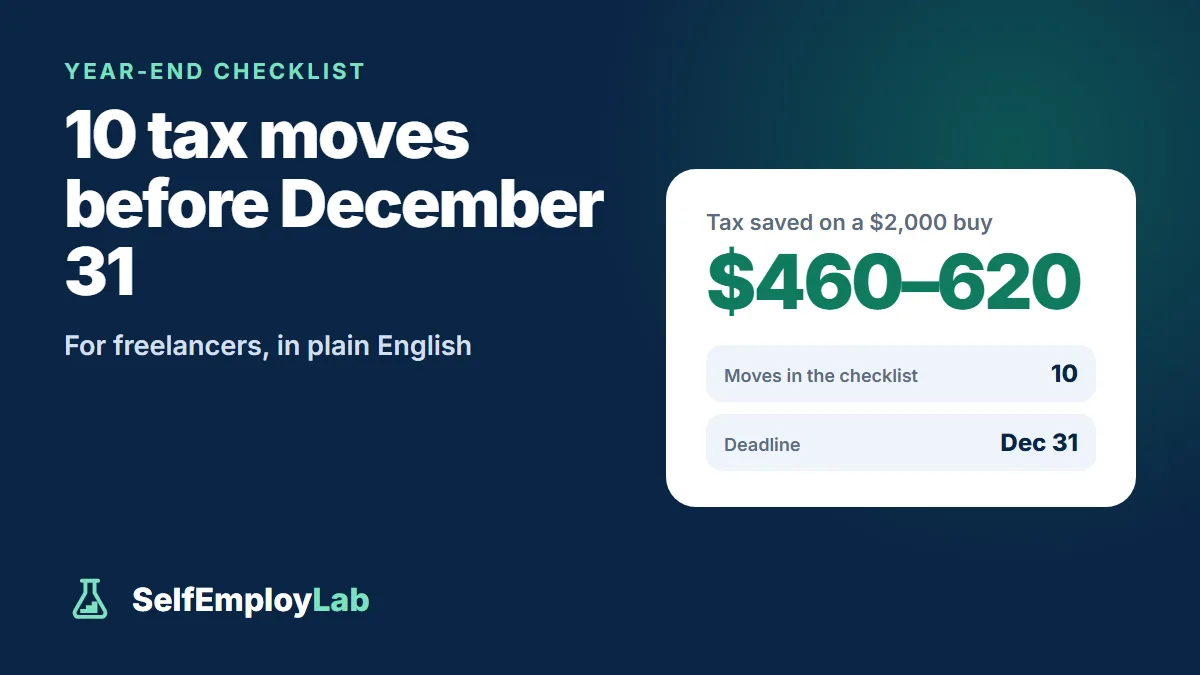
The rule is “need”, not “spend”. A $2,000 purchase only saves the tax on $2,000 — roughly $460 to $620 in federal tax for a single filer with $50,000 to $160,000 of profit once self-employment tax is included. Buying something you don’t need to save tax still leaves you poorer.
3. Pay deductible bills in December
Most freelancers use the cash method: an expense counts in the year you pay it. Paying a software renewal, professional membership, or business insurance premium in December rather than January moves the deduction into 2026. Card payments count when the charge is made, not when you pay the card bill. Prepaying more than a year ahead generally doesn’t work — the benefit must not extend beyond 12 months or past the end of next year.
Go through your accounts for expenses you haven’t categorized yet. Our list of deductions freelancers often miss is a good prompt.
4. Think about when income lands
Under the cash method, income counts when you receive it — or when it is made available to you. Sending a final invoice in late December with January payment terms usually moves that income into 2027, which can help if you expect a lower bracket next year. But you can’t turn down a check that’s already in hand, or leave money sitting in a payment app, to delay the tax. If 2027 looks like a higher-income year, the opposite logic applies.
5. Decide on a retirement plan
Retirement contributions are one of the biggest deductions available to the self-employed, but the deadlines differ by plan:
- Solo 401(k): allows the largest contributions at moderate income because you contribute as both employee and employer. Its setup and deferral rules are stricter than a SEP’s, so open the account and talk to the provider before December 31.
- SEP-IRA: can be opened and funded until your filing deadline, including extensions — up to October 15, 2027 for 2026 if you extend.
- Traditional or Roth IRA: 2026 contributions until April 15, 2027.
Compare the two business plans in SEP-IRA vs Solo 401(k). Retirement contributions lower income tax, not self-employment tax.
6. Total your mileage
If you drive for business, close out your 2026 log now while you still remember the trips. The standard mileage rate changed mid-year: 72.5 cents a mile through June 30 and 76 cents from July 1, 2026, so total the two halves separately. See the 2026 mileage deduction guide.
7. Collect W-9s from contractors
If you paid any independent contractor $2,000 or more for services in 2026, you’ll need to send them a Form 1099-NEC by February 1, 2027. Ask for a Form W-9 (name, address and taxpayer ID) now, before everyone is on holiday. Payments made by card or through a payment app don’t go on a 1099-NEC.
8. Check your health coverage and HSA
Premiums for health, dental and long-term care insurance you pay as a self-employed person can often be deducted — see the self-employed health insurance deduction. If you have a high-deductible plan, you can contribute to a health savings account for 2026 until April 15, 2027.
9. Decide whether 2027 is your S corp year
If your profit has grown, the S corp question is worth answering before the new year. To be taxed as an S corp for all of 2027, the election (Form 2553) is generally due by March 15, 2027, and you’d need payroll running from the start of the year. Run your own numbers in the S corp tax savings calculator first — the saving is often smaller than people expect.
10. Put the 2027 dates in your calendar
January 15, February 1, March 15 and April 15 come quickly. Our 2027 tax deadline calendar for freelancers lists every date, and you can sign up below for a free reminder email before each estimated payment.
Frequently asked questions
Should I buy equipment in December just to save tax?
Only if you’d buy it anyway. Timing a purchase you already need into December gets you the deduction a year earlier; buying something you don’t need costs more than the tax it saves.
If I pay a business expense with a credit card on December 30, which year does it count in?
Generally 2026 — for a cash-method taxpayer the expense is paid when it’s charged to the card, even if you pay the card balance in January.
Can I still lower my 2026 tax after December 31?
Yes, a little. SEP-IRA, IRA and HSA contributions can still be made for 2026 into 2027, up to their deadlines. Most other moves — buying equipment, paying expenses, timing income — need to happen by December 31.