Quick answer
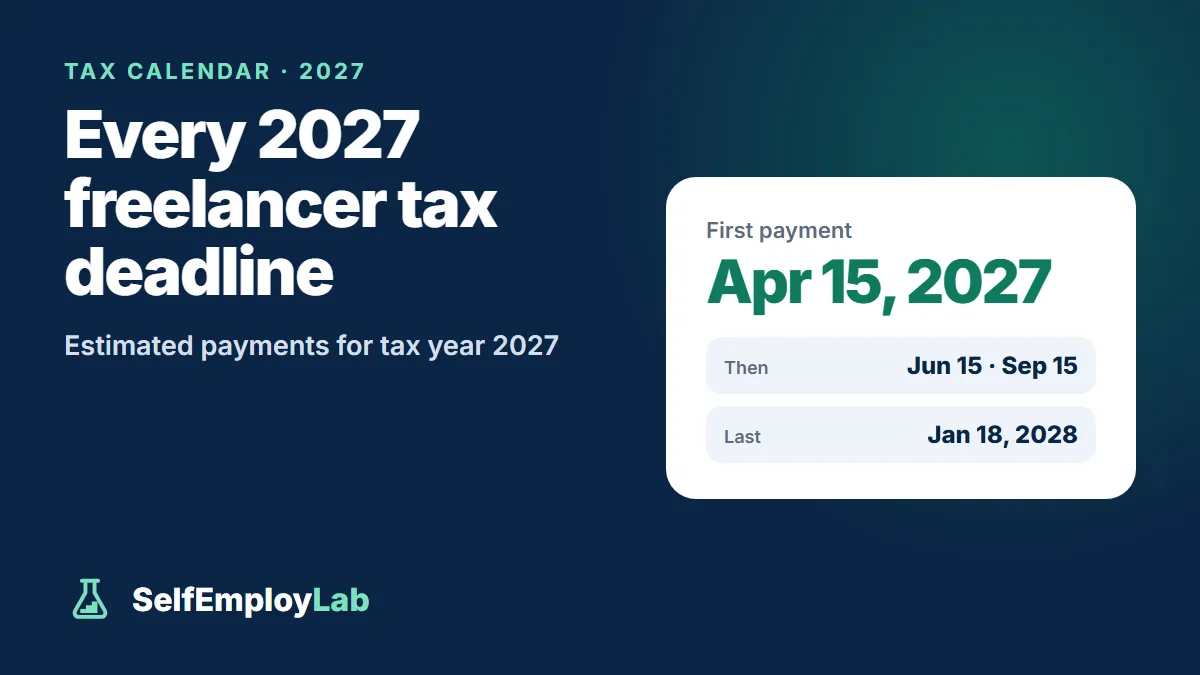
The key 2027 dates for freelancers are January 15 for the fourth 2026 estimated payment, February 1 for 1099-NECs, March 15 for S corp returns and Form 2553, and April 15 for your 2026 Form 1040 and first 2027 estimate. The remaining 2027 estimates are due June 15, September 15 and January 18, 2028.
Freelancers have more tax dates than employees: four estimated payments a year, information returns for anyone you paid, and the annual return. Here is every federal date that matters in 2027, in order — for your 2026 return and your 2027 estimated tax.
The 2027 calendar at a glance
| Date | What’s due |
|---|---|
| January 15, 2027 | 4th estimated tax payment for 2026 (income earned September–December 2026) |
| February 1, 2027 | Forms 1099-NEC to contractors you paid and to the IRS; deadline to file your 2026 return and skip the January payment |
| March 15, 2027 | S corporation (Form 1120-S) and partnership (Form 1065) returns; Form 2553 to be taxed as an S corp for 2027 |
| April 15, 2027 | 2026 Form 1040 and any balance due; 1st estimated payment for 2027; last day for 2026 IRA and HSA contributions; extension request (Form 4868) |
| June 15, 2027 | 2nd estimated payment for 2027 |
| September 15, 2027 | 3rd estimated payment for 2027; extended S corp and partnership returns |
| October 15, 2027 | Extended 2026 Form 1040; last day to fund a SEP-IRA for 2026 if you extended |
| January 18, 2028 | 4th estimated payment for 2027 (January 15 is a Saturday and January 17 is Martin Luther King Jr. Day) |
Add every date to your calendar: download the free 2027 freelancer tax calendar (.ics). It works with Google Calendar, Apple Calendar and Outlook, and each date comes with a reminder three days before.
When a deadline falls on a weekend or federal holiday, it moves to the next business day. That is why the 1099 deadline, normally January 31, is February 1 in 2027.
January 15: the payment people forget
The fourth estimated payment for 2026 is due in January 2027, after the year has ended — which is exactly why it gets missed. It covers income you earned from September through December 2026.
There is one way to skip it: if you file your 2026 return by February 1, 2027 and pay the entire balance with it, you don’t have to make the January 15 payment. That only works if your records are ready early, so most freelancers simply pay in January.
When you pay online, check that the payment is applied to tax year 2026, not 2027. See how to pay estimated taxes online, and work out the amount with the quarterly estimated tax calculator.
February 1: 1099s for people you paid
If your business paid an independent contractor $2,000 or more for services in 2026, you generally owe them a Form 1099-NEC, and a copy goes to the IRS — both by February 1, 2027. ($2,000 is the new threshold for payments made in 2026; it was $600 before.) Payments you made by credit card or through a payment app are reported by the card company or app instead.
On the receiving side, expect your own 1099-NEC forms from clients by the same date. A 1099-K from a payment platform arrives only if you passed both $20,000 and 200 transactions on that platform. Either way, all of your income is taxable, form or no form. Read 1099-NEC vs 1099-K for the details.
March 15: S corps and the S corp election
If your business is already an S corporation or a multi-member LLC taxed as a partnership, its return is due March 15, 2027 (or September 15 with an extension). Owners need the Schedule K-1 from that return before they can finish their own.
March 15 is also the usual last day to file Form 2553 if you want S corp tax treatment to start with 2027 — the election generally has to be made within 2 months and 15 days of the start of the tax year. Before you do, check whether it actually saves money with the S corp tax savings calculator.
April 15: the big one
Four things land on April 15, 2027:
- Your 2026 Form 1040, with Schedule C and Schedule SE, and payment of anything you still owe.
- Your first 2027 estimated payment. Many people forget that this falls on the same day as the return.
- The last day to contribute to an IRA or HSA for 2026.
- The extension deadline. Filing Form 4868 moves the deadline to file to October 15, 2027 — but not the deadline to pay. Interest and late-payment penalties still run from April 15 on any tax you haven’t paid.
A SEP-IRA for 2026 can be opened and funded up to your filing deadline, including an extension, so it is still available in April. Compare it with a Solo 401(k) in SEP-IRA vs Solo 401(k).
The 2027 estimated payments
| Payment | Covers income earned | Due date |
|---|---|---|
| 1st | Jan 1 – Mar 31, 2027 | April 15, 2027 |
| 2nd | Apr 1 – May 31, 2027 | June 15, 2027 |
| 3rd | Jun 1 – Aug 31, 2027 | September 15, 2027 |
| 4th | Sep 1 – Dec 31, 2027 | January 18, 2028 |
The periods aren’t equal — the second covers just two months and the fourth covers four. You generally need to pay estimated tax if you expect to owe at least $1,000 when you file. To avoid an underpayment penalty, pay at least 90% of your 2027 tax, or 100% of your 2026 tax (110% if your 2026 adjusted gross income was over $150,000), spread across the four dates. If you already missed one, see what happens if you miss a quarterly payment.
State deadlines
Most states with an income tax use the same April 15 filing date and follow similar quarterly dates for estimated payments, but not all of them, and some cities add their own. Check your state guide for the details.
If you live in a disaster area
After hurricanes, wildfires and other declared disasters, the IRS often postpones deadlines for affected counties, sometimes by several months. These relief notices are published on the IRS “Tax relief in disaster situations” page and apply automatically to people in the covered area.
Frequently asked questions
Is the January 15 payment for this year or last year?
Last year. The payment due January 15, 2027 is the fourth installment of your 2026 estimated tax.
Does an extension give me more time to pay?
No. An extension gives you until October 15 to file, but tax is still due April 15. Pay your best estimate with the extension request to keep interest and penalties down.
Do I have to make estimated payments in my first year?
If you expect to owe $1,000 or more, generally yes. In a year when your prior-year tax was zero, though, there is usually no underpayment penalty. Our first-year freelancer tax checklist walks through it.