Quick answer
Yes. If you have a W-2 job, enter extra tax per paycheck in Step 4(c) of Form W-4 instead of paying quarterly. Size it to cover side-hustle income tax plus 15.3% self-employment tax on 92.35% of profit. Withholding counts as paid evenly through the year, so it can also fix earlier underpaid quarters.
If you have a W-2 job, you can cover the tax on your side hustle by having your employer withhold more from each paycheck instead of sending the IRS quarterly estimated payments. Enter the extra amount per pay period in Step 4(c) of your 2026 Form W-4, and size it to cover both the income tax and the self-employment tax on your side profit.
It is often the easier route, and it has one advantage estimated payments don’t: withholding can still repair a shortfall from earlier in the year.
Why withholding beats a late estimated payment
The underpayment penalty is figured separately for each of the four payment periods. A quarterly estimated payment counts on the day you actually make it, so if you skipped the April and June payments, paying in October does not undo the penalty that built up on those quarters.
Withholding gets different treatment. The Instructions for Form 2210 say you are considered to have paid one-fourth of your federal income tax withholding on each payment due date unless you show otherwise. Extra tax withheld from your November and December paychecks is spread back across all four quarters, including the ones you missed.
And although it is called income tax withholding, it counts against your whole tax bill. The 2026 Form W-4 instructions say that if you want to pay your income tax and self-employment tax through withholding from your wages, you can.
Step 4(a) or Step 4(c)?
Form W-4 gives you two ways to ask for more withholding. They work differently.
| Step 4(a): Other income | Step 4(c): Extra withholding | |
|---|---|---|
| What you enter | An annual amount of income | A dollar amount of tax per pay period |
| How payroll uses it | Adds it to your annual wages when figuring income tax withholding | Adds it straight to the tax taken from each check |
| Meant for | Interest, dividends, retirement income | Anything, including self-employment |
| Covers self-employment tax? | No | Yes, if you size it for it |
The 2026 W-4 instructions say plainly that you shouldn’t include income from any jobs or self-employment in Step 4(a). There’s a mechanical reason too. Under Publication 15-T, your employer just adds the Step 4(a) amount to your wages and runs the normal income tax calculation. That gets the income tax roughly right, but it never adds the 15.3% self-employment tax.
Step 4(c) is the cleaner fit. You work out the tax yourself, divide it by your paychecks, and payroll takes exactly that much more each time. It also tells your employer nothing about your side business.
Use the IRS Tax Withholding Estimator first
For anyone with self-employment income, the W-4 itself recommends the IRS Tax Withholding Estimator at irs.gov/W4App. It asks about your jobs, other income and deductions, and at the end it can produce a pre-filled Form W-4 for you to give your employer. The IRS says it takes about 25 minutes. Before you start, have your latest pay stubs (they show the tax withheld so far this year), last year’s return, and your self-employment payment records ready.
If you’d rather check the math by hand, the method is simple.
How to size the extra amount
- Estimate your side-hustle profit for the year: income minus business expenses.
- Self-employment tax = profit × 92.35% × 15.3%. Our self-employment tax calculator does this step.
- Income tax on the profit = (profit − half of the SE tax) × your top bracket rate. Half of your SE tax is deductible.
- Subtract any estimated payments you’ve already made for 2026.
- Divide by the number of paychecks left in the year once the new W-4 takes effect.
Worked example: $10,000 of side profit
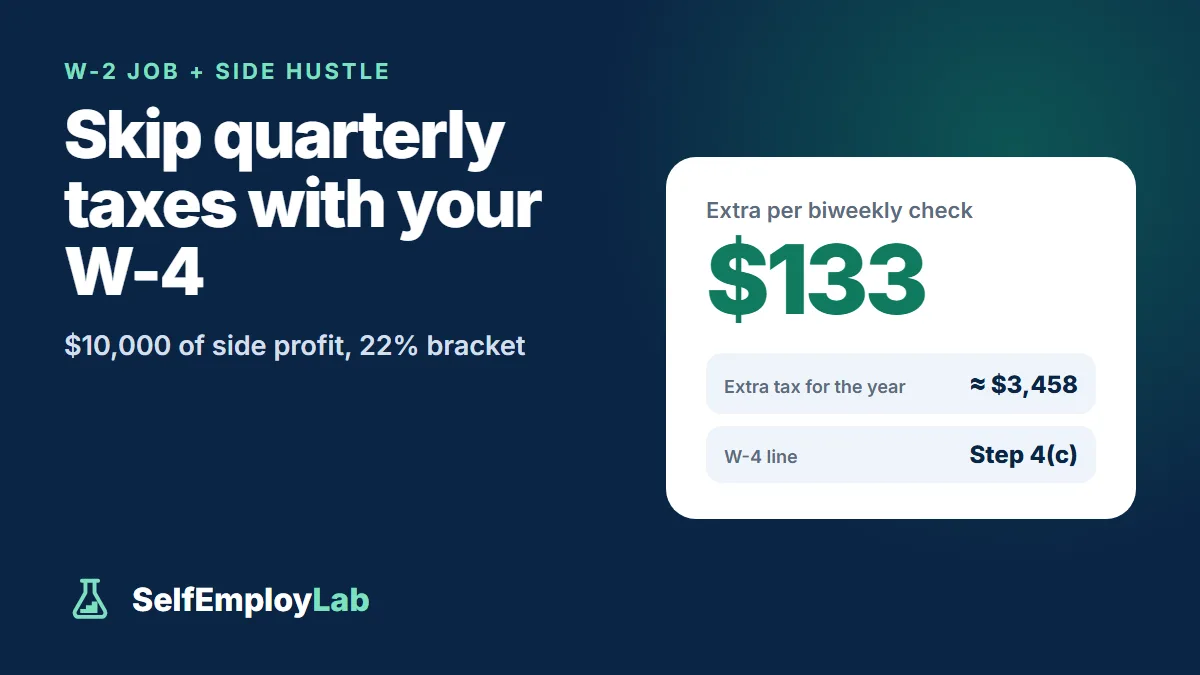
Say you’re single, earn a $75,000 salary and expect $10,000 of profit from freelance design in 2026. After the $16,100 standard deduction, your salary leaves about $58,900 of taxable income. Add the side profit and you’re still under $105,700, the top of the 22% bracket, so every extra dollar is taxed at 22%.
| Step | Math | Result |
|---|---|---|
| Net earnings subject to SE tax | $10,000 × 92.35% | $9,235.00 |
| Self-employment tax | $9,235 × 15.3% | $1,412.96 |
| Deduction for half of SE tax | $1,412.96 × 50% | $706.48 |
| Profit taxed as income | $10,000 − $706.48 | $9,293.52 |
| Income tax on the profit | $9,293.52 × 22% | $2,044.57 |
| Total extra tax for the year | $1,412.96 + $2,044.57 | ≈ $3,458 |
Now spread it over your paychecks. If you’re paid every two weeks:
| When the new W-4 takes effect | Biweekly paychecks left | Enter in Step 4(c) |
|---|---|---|
| Start of the year | 26 | $133 |
| Midyear | 13 | $266 |
| Late in the year | 5 | $692 |
A few caveats on this example. Social Security tax applies only to the first $184,500 of combined wages and self-employment earnings in 2026, so a high earner pays less SE tax. If you qualify for the qualified business income deduction, your income tax will come in a bit lower. And if part of your profit falls in a different bracket, use that rate for that part.
The safe harbors still apply
Withholding counts toward the same safe harbors as estimated payments. For 2026, you generally avoid the underpayment penalty if you owe less than $1,000 after withholding and credits, or if your withholding and on-time payments cover at least 90% of your 2026 tax or 100% of your 2025 tax. That second figure is 110% if your 2025 AGI was over $150,000 ($75,000 married filing separately). Matching last year’s tax is often the easiest target, and the quarterly estimated tax calculator shows that minimum.
One more thing: once the year is over, take the extra amount out of Step 4(c) or recalculate it. The IRS suggests checking your withholding every January, and again in late December if you changed it during the year.
When quarterly payments are still the better choice
- Your W-2 job is ending, or you are going part-time, so there won’t be enough paychecks left to absorb the extra.
- Your side income is unpredictable. Estimated payments let you pay after a big month instead of guessing in advance. The annualized income method on Form 2210 can also lower what was due for early quarters if most of your profit came late.
- The extra withholding would squeeze your budget more than setting aside each client payment would.
- You want to hold the cash until each due date instead of having it taken out every payday.
You can also do both. Many people withhold a steady base amount through Step 4(c) and send an estimated payment after an unusually good quarter. If you file jointly, the extra can come from either spouse’s paycheck. Publication 505 lets you split it between the two jobs any way you like.
Don’t forget state withholding
All of this is federal. If your state has an income tax, your side profit is probably taxable there too, and the federal W-4 doesn’t change your state withholding. Some states have their own withholding certificate with its own “additional amount” line. Others rely on the federal form or handle extra withholding differently. Check your state revenue department’s withholding form, or make state estimated payments separately.
For the bigger picture on what you owe, from 1099 thresholds to Schedule C, start with our side hustle taxes guide.
Frequently asked questions
Should I use Step 4(a) or Step 4(c) for side-hustle income?
Use Step 4(c). The 2026 Form W-4 instructions say not to include self-employment income in Step 4(a), and Step 4(a) only raises income tax withholding, so it never covers the 15.3% self-employment tax.
Can extra withholding fix a quarterly payment I already missed?
Usually, yes. Federal income tax withheld is treated as paid one-fourth on each payment due date unless you show otherwise, so extra withholding late in the year counts toward earlier quarters too. A late estimated payment only counts from the day you pay it.
How much extra should I withhold on $10,000 of side profit?
At a 22% bracket, self-employment tax is about $1,413 and income tax on the profit after the half-SE-tax deduction is about $2,045, so about $3,458 in total. That works out to $133 per biweekly check over 26 paychecks, or $692 if only 5 are left.
How fast does a new W-4 take effect?
Your employer must apply it no later than the start of the first payroll period ending on or after the 30th day after you turn it in. Only count paychecks that will reflect the change.