Quick answer
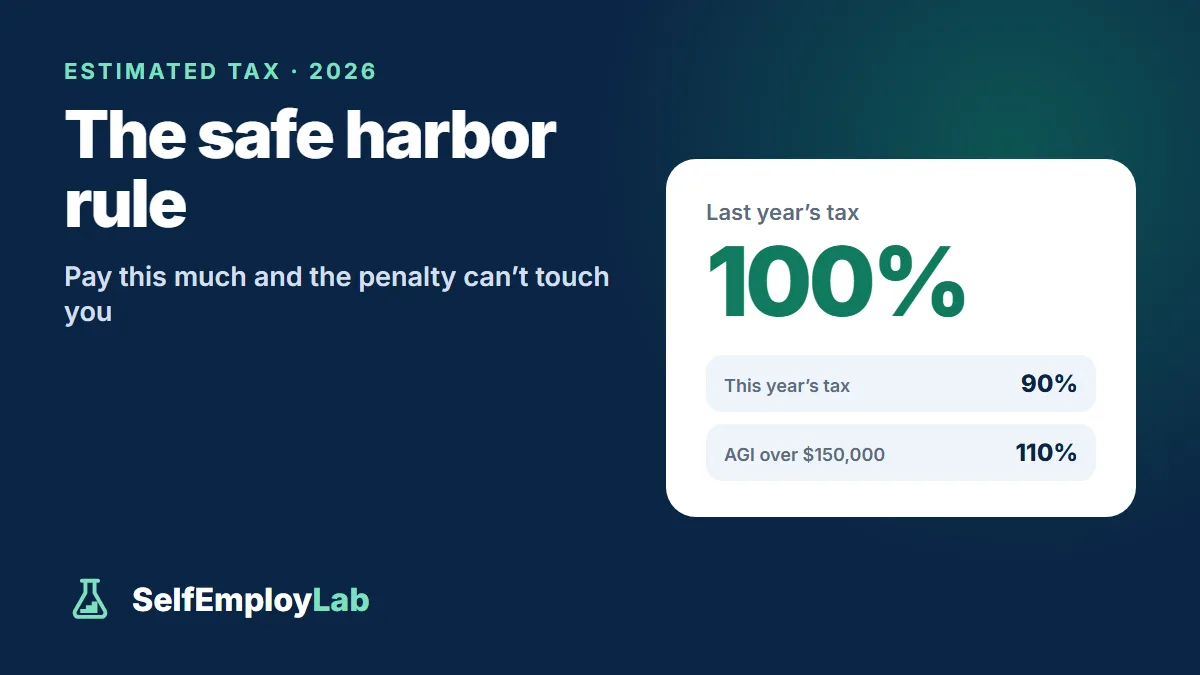
For 2026 you avoid the underpayment penalty if withholding and on-time estimated payments cover the smaller of 90% of your 2026 tax or 100% of your 2025 tax, or 110% if 2025 AGI topped $150,000 ($75,000 married filing separately). Each of the four installments must be one-fourth of that amount, unless you use the annualized method.
You avoid the IRS underpayment penalty for 2026 if your withholding and on-time estimated payments add up to at least the smaller of 90% of your 2026 tax or 100% of your 2025 tax — 110% if your 2025 adjusted gross income was over $150,000 ($75,000 married filing separately). You also owe no penalty if your balance due after withholding and credits is under $1,000. The rest of this guide explains how those rules work quarter by quarter and how to pick the one that fits your year.
The three safe harbors
The IRS calls the amount you must have paid in the required annual payment. For 2026 it is the smaller of:
- 90% of the tax on your 2026 return, or
- 100% of the tax on your 2025 return, as long as that return covered all 12 months.
If the AGI on your 2025 return (Form 1040, line 11b) was more than $150,000, or more than $75,000 if your 2026 filing status is married filing separately, the second option becomes 110% of your 2025 tax.
“Tax” here means your total tax, including self-employment tax, not just income tax. That matters for freelancers, because self-employment tax is often the larger piece.
Two situations need no planning at all:
- Under $1,000. If your 2026 tax minus withholding and refundable credits is less than $1,000, there is no penalty.
- No tax last year. If you had no tax liability for 2025, were a U.S. citizen or resident all year, and your 2025 tax year was a full 12 months, you are not required to pay estimated tax for 2026.
Which safe harbor should you use?
The two main options serve different purposes:
| Prior-year (100% or 110%) | Current-year (90%) | |
|---|---|---|
| Target known in advance? | Yes — it is on last year’s return | No — you are estimating |
| Best when | Income is rising or unpredictable | Income is falling |
| Risk | A large balance due in April | Penalty if you underestimate |
The prior-year safe harbor is the planner’s favorite because it is a fixed number. Once you file your 2025 return, you know exactly what keeps you penalty-free in 2026, no matter how much more you earn. The trade-off is that any tax above that number is still due by the April filing deadline — the safe harbor removes the penalty, not the tax.
The current-year option helps when your income drops. If last year was a big year and this year is slower, paying 90% of this year’s smaller tax can mean much smaller payments.
It applies to each installment, not just the year
Meeting the safe harbor in total by January is not enough. For most people, each of the four installments must be one-fourth of the required annual payment, paid by its due date. The 2026 due dates are:
- April 15, 2026
- June 15, 2026
- September 15, 2026
- January 15, 2027
You can skip the January payment if you file your 2026 return by February 1, 2027 and pay the entire balance with it. The IRS figures the penalty separately for each installment due date, so you can owe a penalty for an early quarter even if you later catch up — and even if you end up with a refund. See the full calendar in tax deadlines for freelancers, and how to pay estimated taxes online for payment options.
Uneven income: the annualized income installment method
Equal quarterly payments assume you earn evenly. Many freelancers don’t — a big contract in the fall, or a business that only took off in the second half. If most of your income arrived late in the year, the annualized income installment method lets each required installment follow when you actually earned the money.
You figure it on Form 2210, Schedule AI. It looks at your income in four cumulative periods — January 1 through March 31, through May 31, through August 31, and the entire year — annualizes each one, and requires a growing share of the resulting tax by each due date (22.5%, 45%, 67.5% and 90% under the 90% rule). If your income was low early on, your early installments shrink, and the penalty for those quarters can shrink or disappear.
If you use this method, you must check box C in Part II of Form 2210 and attach the form and Schedule AI to your return, even if no penalty is owed in the end.
W-2 withholding counts as paid evenly
If you or your spouse has a job, federal tax withheld from wages gets special treatment: the IRS treats one-fourth of the year’s withholding as paid on each installment due date, unless you show otherwise. So withholding taken out in December counts as if it had been spread across all four quarters.
That makes withholding the most flexible tool you have. If you are running behind on estimates, filing a new Form W-4 to raise withholding for the rest of the year can cover earlier quarters retroactively in a way a late estimated payment cannot. (You can instead elect to treat withholding as paid on the actual dates it was withheld, by checking box D on Form 2210 — useful only if most of it came early.)
Farmers and fishers
If at least two-thirds of your gross income for 2025 or 2026 is from farming or fishing, the 90% figure drops to 66⅔%, and the 110% rule for higher incomes does not apply. You also get a simpler schedule: either pay all of your 2026 estimated tax by January 15, 2027, or file your 2026 return by March 1, 2027 and pay the total tax due, in which case no estimated payments are required.
How the penalty is calculated if you fall short
The underpayment penalty works like interest. For each installment, the IRS takes the amount you were short and charges the underpayment rate for the number of days it stayed unpaid. That rate is the federal short-term rate plus 3 percentage points, and the IRS resets it every quarter.
The published rates for 2026 so far:
| Quarter | Underpayment rate |
|---|---|
| January–March 2026 | 7% |
| April–June 2026 | 6% |
| July–September 2026 | 7% |
| October–December 2026 | 7% |
The penalty on a 2026 shortfall can keep running until April 15, 2027, so part of it will use a 2027 rate the IRS has not announced yet. For a rough sense of scale: $3,000 short for 90 days at 7% is about $52. If you have already missed a payment, see what to do after a missed quarterly payment.
Example 1: income jumps from ,000 to 0,000
2025: $60,000 profit, total tax of $12,000 on her return (income tax plus self-employment tax). AGI well under $150,000.
2026: she expects $120,000 of profit and about $28,500 of total tax.
Current-year safe harbor: 90% × $28,500 = $25,650.
Prior-year safe harbor: 100% × $12,000 = $12,000.
Required annual payment: the smaller, $12,000 — four payments of $3,000.
Result: no penalty, but about $16,500 is still due by April 15, 2027. She should set that money aside as it comes in.
This is the classic use of the prior-year rule: she does not need to forecast her growth accurately to stay penalty-free. She just needs to have the balance ready in April.
Example 2: a high earner who needs 110%
2025 total tax: $52,000. Because AGI was over $150,000, the prior-year safe harbor is 110% × $52,000 = $57,200 ($14,300 a quarter).
2026 projection: $60,000 of tax, so the current-year safe harbor is 90% × $60,000 = $54,000.
On paper the required payment is the smaller $54,000 — but only if the projection holds. If a late contract pushes 2026 tax to $66,000, 90% becomes $59,400 and $54,000 would fall short.
Paying $57,200 is protected regardless of how 2026 turns out.
High earners with unpredictable income often pay the 110% figure for that reason, then adjust only if income clearly falls.
Plan it in one step
The quarterly estimated tax calculator shows your projected tax, the safe-harbor minimum based on last year’s tax, and the quarterly amount for each. Run it once in spring with last year’s return in hand, then again mid-year if your income changes sharply.
Frequently asked questions
Does the safe harbor mean I won't owe any tax in April?
No. The safe harbor only removes the underpayment penalty. If you paid 100% of last year's tax but earned more this year, the remaining balance is still due by the April filing deadline, April 15, 2027 for 2026 tax.
When do I need to use 110% instead of 100%?
Use 110% of last year's tax if the AGI on your 2025 return was more than $150,000, or more than $75,000 if your 2026 filing status is married filing separately. The 110% rule does not apply if at least two-thirds of your gross income is from farming or fishing.
Can I pay most of my estimated tax late in the year if my income came late?
Yes, if you use the annualized income installment method on Form 2210, Schedule AI. It sets each required installment based on income earned through March 31, May 31, August 31 and the full year, and you must attach it to your return.
How does W-2 withholding help with the safe harbor?
The IRS treats one-fourth of your year's wage withholding as paid on each installment due date, unless you show otherwise. Raising withholding with a new Form W-4 late in the year can therefore cover shortfalls from earlier quarters.